Simay Azadi English

Special Production

News, Special Production

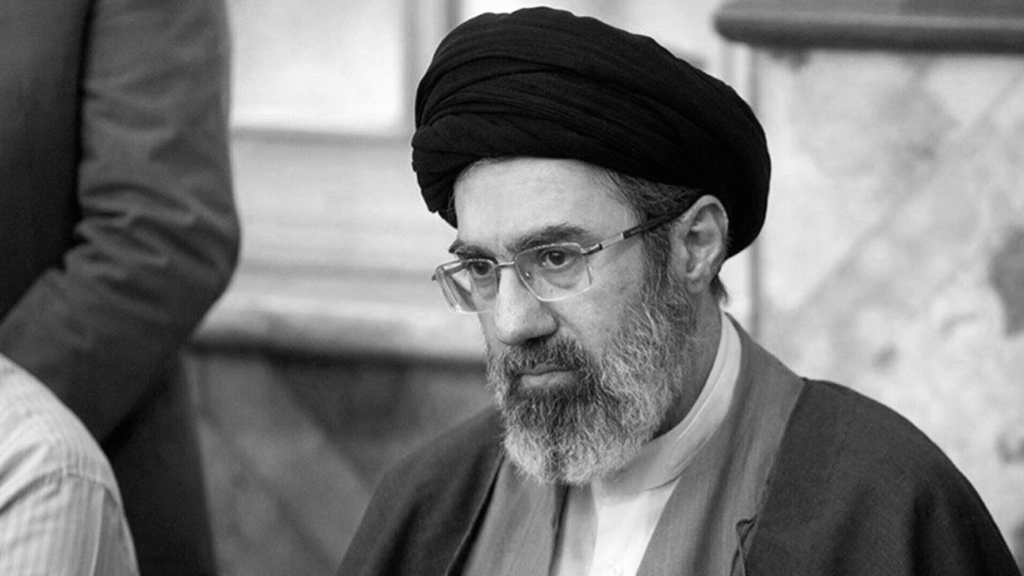
Who is Mojtaba Khamenei? Iran’s New Supreme Leader  

The Life, Crimes, and Dynastic Rise of Mojtaba Khamenei  March 8, 2026 — On March 8, the Iranian regime’s Assembly of Experts officially chose Mojtaba Khamenei to succeed his father as Supreme Leader. While the state presents him as a man of faith, investigative dossiers reveal a “corrupted prince” who has spent decades commanding paramilitary death squads and amassing a private fortune through the systematic pillaging of Iran’s oil wealth.  I. The Indoctrination of a Successor  Born on September 8, 1969, in Mashhad, Mojtaba was groomed within the regime’s most elite and controversial circles.  II. The “Commander of the Coup” (2005–2009)  Mojtaba’s rise to power is inseparable from the subversion of Iran’s elections and the blood spilled on Tehran’s streets.  III. Regional Ambitions: The “Iraq Iftar”  Mojtaba has long acted as a shadow diplomat, directing regional instability alongside the late Qasem Soleimani then commander of the IRGC’s Quds Force.  IV. The Global Property Empire: The Bloomberg Investigation  A recent landmark investigation by Bloomberg has exposed how Mojtaba used a network of shell companies and loyal oligarchs to shield a massive international real estate portfolio from the Iranian public.  V. Financial Crimes & The 1.6 Billion Euro Embezzlement  Mojtaba’s name is synonymous with the pillaging of the public treasury (Beit-al-Mal).  Conclusion: A Legacy of Repression  By elevating Mojtaba Khamenei on March 8, the Assembly of Experts has once again showed that the regime lacks any pretense of religious or popular legitimacy. Mojtaba takes the throne as a leader who is already reviled for:  His reign begins with a nation united by a single, decades-old slogan: “Mojtaba bemiri, Rahbari ro nabini” (Mojtaba, may you die and never see the Leadership). The “Shadow Prince” has become the Sultan, but he inherits a country that has already rejected his family’s right to rule, as it rejected the rule of the Shah and his son.  

News, Special Production

Iran: 88th Week of “No to Execution Tuesdays” – 871 Executions in First Half of 2025

September 30, 2025 – In the 88th week of the “No to Execution Tuesdays” campaign, prisoners in 52 prisons across Iran launched coordinated hunger strikes to protest executions carried out by the genocidal regime. In its statement, the campaign declared:“This week, once again, with deep sorrow and endless solidarity, we stand in memory of Somayeh Rashidi, a political prisoner who lost her life due to lack of medical care. This oppressed death is part of the policy of ‘torturing prisoners to death’ and a bitter warning about the situation of sick prisoners in the country’s prisons—prisoners who have been deprived of the most basic human rights.” The campaign expressed “heartfelt condolences to her family and friends.” The statement highlighted recent cases: Execution of Bahman Choobi Asl on espionage charges on September 28 after a secretive process Death sentences for political prisoners Hamed Validi and Nima Shahi in the Revolutionary Court of Karaj Supreme Court approval of the execution sentence for Peyman Farahavar According to the campaign:“These unjust sentences are clear violations of human rights and tools of repression that must be stopped immediately.” International attention also intensified. The campaign noted:“The position of Ms. Mae Sato, the UN Special Rapporteur on human rights, regarding widespread violations of prisoners’ rights in Iran once again drew the attention of the world to the catastrophic situation of the prisons.” The campaign provided alarming statistics:“46 executions in the past week, 190 executions in September—unprecedented in the past 35 years—and 871 executions in the first six months of 2025 give a horrifying picture of the brutal violation of human rights.” The statement concluded:“The ‘No to Execution Tuesdays’ campaign, while condemning these crimes, once again calls for the immediate halt of execution sentences and an end to this inhumane process. Our voice is a cry of solidarity with all prisoners caught in the chains of oppression and injustice. As always, while thanking all supporters of the campaign around the world, we emphasize that the execution machine can be stopped with solidarity and unity. Every act of protest against a death sentence is a step toward stopping this cruel process. We ask all opponents of execution to raise their voices against these inhuman sentences.”

No to Execution Tuesdays Week 78
News, Special Production

Iran 78th Week of “No to Execution Tuesdays”

The “No to Execution Tuesdays” campaign underlines that Iran’s regime Executes 71 in one month amid crackdown on political prisoners July 22, 2025 – In the 78th week of the “No to Execution Tuesdays” campaign, prisoners in 48 prisons across Iran launched coordinated hunger strikes to protest the genocidal regime’s use of the death penalty and escalating repression against political prisoners. Since June 21, Iranian authorities have executed at least 71 individuals. The campaign emphasized that these executions were carried out without fair trials and often relied on forced confessions extracted under duress. “These are not acts of justice—they are acts of terror,” the No to Execution Tuesdays campaign declared in its statement. The surge in executions has been accompanied by intensified persecution of the campaign’s own imprisoned members. Reports from inside prisons detail mounting threats, physical and psychological torture, arbitrary exile to distant facilities, and the harassment and detention of family members. Political prisoners have also been systematically denied basic legal and medical rights. “This systemic repression is part of the regime’s unrelenting attempt to silence a society that, despite all pressure, continues to insist on its right to justice, freedom, human dignity, and self-determination,” the No to Execution Tuesdays campaign stated. This week’s statement reaffirms the campaign’s condemnation of capital punishment and its continued resistance against the regime’s use of execution as a tool of fear. “We wholeheartedly condemn this violent, inhumane, and unjust campaign of executions and repression. Execution is not a path to justice—it is a tool of terror. No state should have the right to take a human life, especially under a judiciary that blatantly violates basic legal rights.” As the “No to Execution Tuesdays” movement enters its 78th week, it remains committed to its demand: the full and permanent abolition of the death penalty in Iran. “Our cry of ‘No to Execution’ will grow louder each week—until the day executions are abolished in Iran forever.”

News, Special Production

“A Crime is in Progress” Saeed Masouri’s Letter From Iran’s Prison- July 17

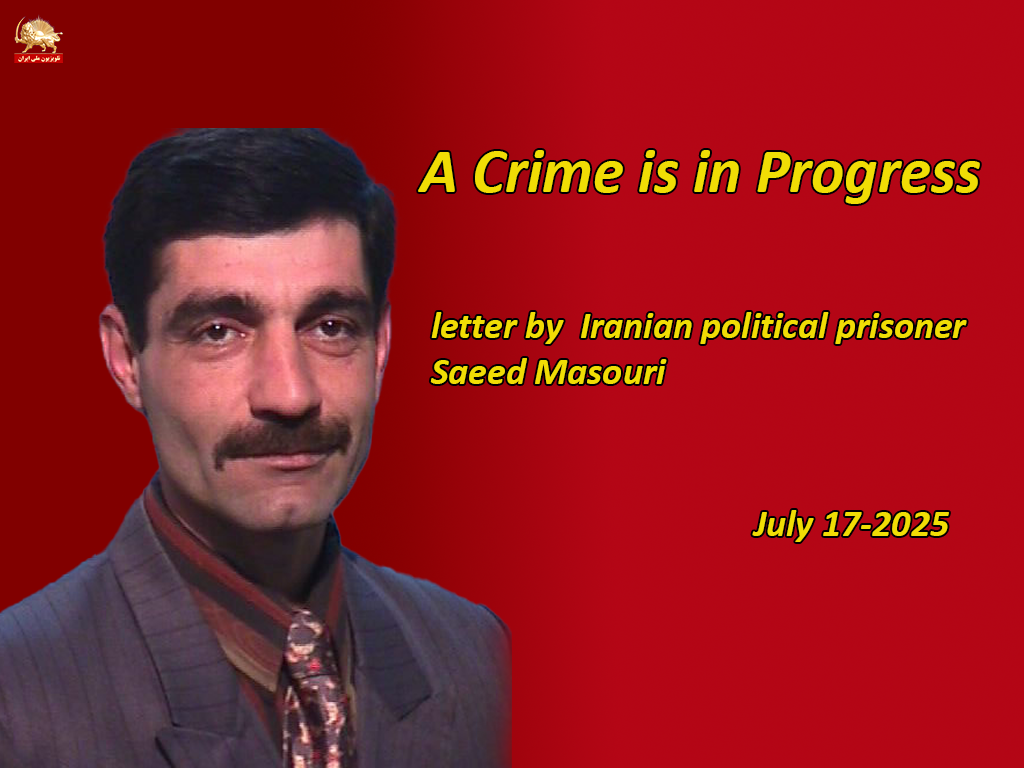
The following is an exclusiveletter from Saeed Masouri, an Iranian political prisoner who has been incarcerated for nearly 25 years. This is his warning to the world. “A Crime is in Progress” by Saeed Masouri Since this morning, they have been trying to transfer me using a thousand and one tricks—threats, enticements, and solemn oaths. What is certain is that this method of operation (abduction within the prison under the guise of a “transfer”) is by no means limited to me; it is fundamentally a tactic to control, isolate, and silence prisoners. The conflict is not about whether I am transferred or not; it is solely about suppression, more suppression, and still more suppression, and an insistence on more killings and executions! It is exactly as it happened in 1988, and today we fear that the same path will be repeated, albeit with different language and methods. Back then, it was called the “Death Committee”; today, it is “fire at will.” But this widespread repression and intensification of executions are not signs of strength, but rather a confession of the regime’s helplessness in the face of truth and the will of the people. In the same vein, this “fire at will” is nothing but an attempt to cover up the depth of infiltration, decay, and structural collapse within the ruling system—a failure they want to compensate for by taking retribution on the people of Iran and their prisoners. My refusal to accept a “transfer” from the exile of Qezelhesar Prison to yet another place of exile is not out of fear of being moved, nor is it due to the delusion that a few of us prisoners can stop these illegal acts. It is solely and exclusively to ensure that the massacre does not happen in silence and obscurity, as it did in 1988, but instead takes place before the eyes of history and awakened consciences! Yes, let the world hear this time that “a crime is in progress”—and that there is resistance against it! Even if this resistance only serves as a warning, an alert for the people of Iran and the world that “a crime is in progress”! Sabran Bani al-Kiram! (Patience, O noble sons!) As for me personally, as a political prisoner and a supporter of the Mojahedin-e Khalq (PMOI/MEK), especially during the days of Muharram and in the presence of the eternal message of Imam Hussein, I want to affirm that the blood of his son, which was thrown to the heavens, continues to rain down upon us Iranians, upon the Shiites, and upon his followers. And far be it from us to take a single step back on the path of freedom and liberation because of this prison, this exile, and these executions. Even if the massacre of all of us serves only as a news report to announce the day of the event and prevents a crime from being carried out in silence! What honor and fortune it would be if we have given this nation and our people just one alert, just one warning, even at the cost of our lives! For Iran and Iranians have learned nothing from their myths of Siavash and Ariobarzanes, and from the epics of Ferdowsi, other than perseverance and resistance. And what an unparalleled honor it is that we have drawn inspiration and learned from them, as well as from the liberating message of Islam, its Prophet of Mercy, and his legendary companions, for whom it is said: Tazul al-jibal wa la tazul (The mountains may move, but you shall not). Alhamdulillah alladhi hadana li hadha wa ma kunna li nahtadiya lawla an hadana Allah (Praise be to Allah, who has guided us to this, and we would never have been guided if Allah had not guided us). Saeed Masouri17 July 2025

News, Special Production

Iran: 77th Week of “No to Execution Tuesdays” – Yazd Prison Joins Campaign as Executions Escalate

July 15, 2025 – The “No to Execution Tuesdays” campaign marked its 77th consecutive week with the participation of prisoners in 48 prisons, including newly-joined Yazd Prison. This ongoing coordinated hunger strike challenges the genocidal regime’s escalating use of executions as a tool of control and repression. In their weekly statement, the campaign reported:“This is the voice of resistance from within the prisons of the Supreme Leader’s system—against executions and state-sponsored killing.” International concern continues to grow. Ms. Mai Sato, UN Special Rapporteur on the situation of human rights in Iran, raised alarms over the fate of three Arab political prisoners—Ali Mojadam, Moein Khanfari, and Mohammadreza Moghaddam—who were recently moved to solitary confinement in Ahvaz and face imminent execution. Their families have received no updates, raising fears of enforced disappearance, a method of state terror frequently used by the regime. Meanwhile, the Ahvaz Revolutionary Court issued two death sentences each for Farshad Etemadi-Far, Masoud Jamei, and Alireza Mardasi, all political prisoners. Separately, retrial requests were rejected for the fourth time for Mehdi Hassani and Behrouz Ehsani, whose cases are marred by serious legal inconsistencies. Authorities continue to deny their lawyers access to case files, citing secrecy—an illegal obstruction widely practiced in political trials. The campaign also reported a sharp increase in executions:At least 44 people have been executed since June 21, including one woman. Two of these executions were carried out in public, in Miandoab and Bukan. The statement emphasized:“This is only the documented number. Every day, on average, two people are being hanged in this regime’s death factories.” The addition of Yazd Prison reflects the growing reach and determination of the campaign, even under intensified crackdowns. The statement affirmed:“This expansion shows the people’s awakening and determination to resist the medieval machinery of death.” Despite heightened threats, the families of the condemned continue to participate in weekly protests. The campaign called on the public to actively confront these state spectacles of fear:“Freedom-loving Iranians must transform these stages of execution into stages of resistance and exposure.” In closing, the campaign urged collective solidarity:“Do not leave these families alone. Our power lies in our unity—and we will sweep away this regime’s apparatus of execution.”

News, Special Production

Iran: The Goharshad Mosque Massacre in Mashhad

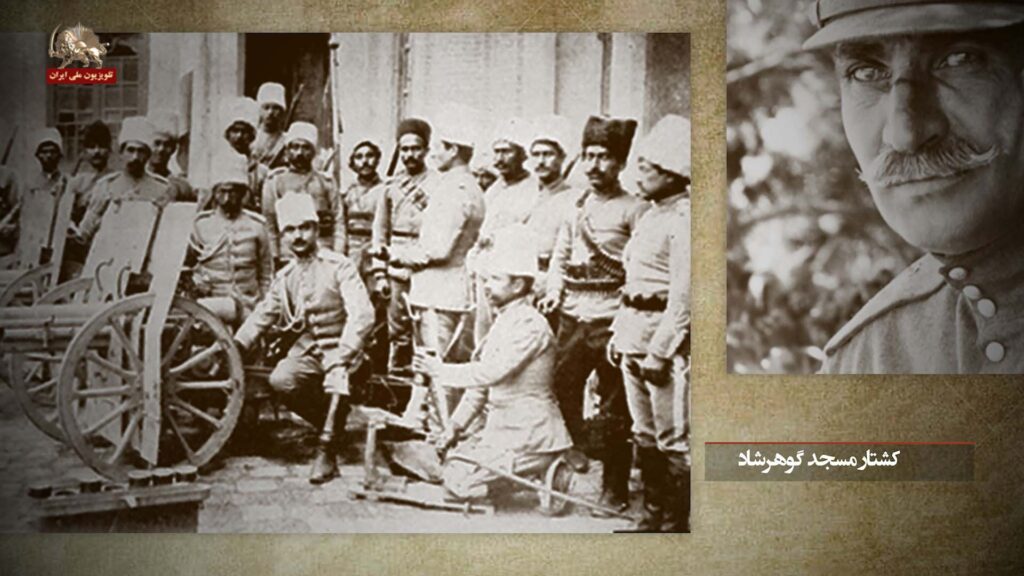
Ordered by Reza Shah The massacre at Goharshad Mosque in Mashhad on July 14, 1935, stands as one of the darkest acts of the Pahlavi monarchical tyranny. The conflict erupted over the forced imposition of Western-style clothing and hats, a policy presented under the guise of modernization but entirely devoid of any political freedom. The tensions that culminated in the massacre began to build in mid-July 1935. On July 10th, authorities began arresting protesters and public speakers. On the evening of July 12th, the order for a military assault was issued. With a battle bugle call, Reza Khan’s army forces attacked protesters who had staged a sit-in at the Goharshad Mosque—the epicenter of the dissent—leaving many killed and wounded. On July 14, 1935, Reza Shah massacred countless souls at Goharshad Mosque for protesting a forced dress code. The crime wasn't just the violence, but the principle: a dictator imposing his will on the people. #No2ShahNo2Mullahs #FreeIran2025 pic.twitter.com/YtjMM9OO87 — SIMAY AZADI TV (@en_simayazadi) July 12, 2025 The slaughter peaked on July 14th. Reza Khan’s forces set up machine guns in the archways of the Goharshad Mosque and positioned artillery on Tehran Street in Mashhad, directly opposite the shrine complex. They continued their assault, killing a great number of people. The bodies of the victims were later buried in mass graves in Mashhad. This event was rooted in the geopolitical shifts of the era. Following the fall of the Tsarist monarchy in Russia and the 1917 October Revolution at the end of World War I, British colonialism sought to build a buffer to protect its Asian colonies, particularly India. To achieve this, Britain orchestrated the rise of Reza Khan, a Cossack officer who had previously been aligned with Tsarist Russia. Through a 1921 colonial coup directed by the British General Edmund Ironside (Commander of British Forces in Iran), Reza Khan was brought to power, and by 1925, he was installed on the throne. Fourteen years after the coup of February 22, 1921, Reza Shah traveled to Turkey in 1935. Upon his return, he issued a directive forcibly banning the hijab for women and mandating the European-style fedora (Shapo) for men. (Source: A Twenty-Year History by Hossein Makki, p. 144 onwards).  A Twenty-Year History by Hossein Makki, p. 144 Similar measures were implemented in both Iran and Afghanistan, seemingly as part of a political bloc guided by a single source: British colonialism. The British aimed to preserve the feudal infrastructure of these countries while introducing certain reforms to protect them from the wave of radical revolutions and socialist republics. A reform or prelude to ruin Iran’s economy and oppress people? This pattern repeated itself four decades later in Iran. During Mohammad Reza Shah’s so-called “White Revolution.” The Shah and his royal court pivoted from the old British colonialism, which was based on feudalism, to a dependent capitalist regime. When John F. Kennedy came to power in the United States in 1961, Iran was once again in a state of crisis, seven years after the 1953 coup against the democratic government of Dr. Mohammad Mossadegh. The Shah was forced to accept the premiership of Ali Amini, who was tasked with implementing reforms, following a teachers’ strike and uprising in May 1962. However, he dismissed Amini 14 months later and took charge of the land reform project himself, under the title of the White Revolution, to fulfill American demands. But in Reza Shah’s time, he himself was the biggest feudal lord in Iran. He left the feudal infrastructure untouched while forcibly seizing lands, especially the fertile lands of northern Iran, under the banner of royal estates. He also encouraged his army commanders to acquire property and real estate. At the same time, to maintain control, particularly in cities that were the base of the urban bourgeoisie and petit bourgeoisie, administrative and judicial reforms were necessary—on the condition that they did not lead to any political reforms related to the freedoms won during Iran’s Constitutional Revolution. The architect of these administrative and bourgeois reforms was Mohammad Ali Foroughi, a veteran British agent who served as Reza Shah’s Prime Minister and advanced his agenda with his British-aligned team. Foroughi was the same man who played a key role, in coordination with the British embassy, in the exile of Reza Khan from Iran in August 1941 and the installation of Mohammad Reza Shah. While Reza Shah accepted the administrative and bourgeois reforms demanded by Britain due to the pressures of the time, political freedom remained an uncrossable red line for his tyranny throughout his reign. For this reason, the foundations of feudalism also remained intact. Similarly, various nationalities, from our Arab compatriots in Khuzestan to those in Baluchistan, Kurdistan, and Lorestan, were subjected to the most severe repression. Meanwhile, the D’Arcy Oil Concession (a petroleum exploration agreement that gave Britain exclusive rights to Iranian oil) was extended in 1933 for another 30 years in favor of British colonialism, accompanied by a great deal of propaganda and fanfare. D’Arcy Oil Concession Had reaction and colonialism not stood in the way of Iran’s Constitutional Revolution and suppressed it, it is clear that the revolution, in the course of its development, would have dismantled the system of large landownership and the feudal regime. But Reza Khan carried out his mission with absolute dictatorship and widespread massacres. The massacre at Goharshad Mosque over the forced imposition of Western clothing and hats, a policy devoid of any political freedom, was one of the products of this dark royal tyranny. What is interesting is that Asadi, the custodian of the Astan-e Quds Razavi (the foundation managing the Imam Reza shrine and Iran’s largest Islamic financial endowment or Moqofati), was opposed to this repression at the time. As a result, he was dismissed and later executed on the Shah’s orders. Reza Khan’s military apparatus blamed Asadi for the turmoil and riots. Another noteworthy point is the position of Ruhollah Khomeini, founder of the current clerical regime, during the massacre. Khomeini, who claimed the status of ijtihad (the authority to

News, Special Production

Crisis After Evin Prison Attack: Prisoners Moved, Conditions Deteriorate

Sudden Transfer of Prisoners to Qarchak and Greater Tehran Under Dire Conditions – Mass Transfer Following Attack on Evin According to reports tallied by the Iranian oppositions, People’s Mojahedin Organization (PMOI/MEK) sources from inside Iran, on June 23, at 7pm local times, approximately 2,000 inmates, including 180 political prisoners from Ward 4 of Evin Prison, were hastily transferred to Fashafouyeh (Greater Tehran Prison) following the attack on Evin. Evin Prison chief Hedayat Farzadi stormed Ward 4 with armed guards, ordering all inmates to evacuate immediately to Greater Tehran Prison, forbidding them from taking any of their belongings. In an attempt to hide the relocation from the outside world, regime officials demolished internal walls between prison sections to carry out the transfer covertly. Prisoners resisted the forced evacuation, raising chants in protest. Farzadi, reportedly too afraid to access his own office or archives, had no official records during the transfer. Instead, he asked prisoners for their names verbally, one by one. The relocated inmates now face severe overcrowding, with 40 people confined per cell, critical food shortages—only one so-called lunch in a plastic bag without a spoon—and just one toilet and one washbasin for every 80 individuals. 🚨BREAKING – EXCLUSIVE: On June 23, 7PM local time, Evin Prison chief Hedayat Farzadi stormed Ward 4 with armed guards, ordering inmates to evacuate to Greater Tehran Prison—no belongings allowed. Regime demolished walls to hide the move. Inmates resisted with chants. #Iran pic.twitter.com/pY1JLwZpnb — SIMAY AZADI TV (@en_simayazadi) June 24, 2025 Meanwhile, female political prisoners transferred to Qarchak Women’s Prison are also at grave risk due to a complete lack of basic medical, sanitary, and living facilities. Despite strict censorship and the regime’s deliberate efforts to conceal its crimes against prisoners—particularly political inmates—much of the information in this report has been provided by courageous sources from within Iran. Qarchak Women’s Prison in Varamin: Life in the “Club” Next to a Waste Incinerator Following the explosion at Evin, female political prisoners were transferred to Qarchak Women’s Prison in Varamin without any access to first aid, even though several were injured. Their new holding area is a section known as the “Club”—a metal shed with no windows, no ventilation, and located directly beside a waste incineration site. According to informed sources, the health and environmental conditions in this facility are described as “unbearable.” The transfer occurred so abruptly that many prisoners could not retrieve medications, personal belongings, or medical documents. Several of the women suffer from chronic illnesses and still have no access to essential medication, nor have they been allowed to retrieve them. As of the time of this report, no official information about the registration of these women appears in Qarchak’s prison system, raising serious concerns about their legal and physical status. Whether this relocation is temporary or permanent remains unknown, adding to the distress of families and human rights advocates. Living and Humanitarian Conditions in Qarchak: A System in Collapse Reports from inside Qarchak reveal critical failures in sanitation, nutrition, medical care, and overall safety: Inmates only have access to salty, undrinkable water. Their only option for clean drinking water is to purchase bottled water at inflated prices from the prison store. Structural Corruption and an Internal Mafia Testimonies from within the prison describe a powerful internal mafia that obstructs access to legal aid and medical treatment. Soghra Khodadadi, the prison director, along with the head of the women’s ward and several guards, are named by prisoners as enforcers of this informal power structure. According to inmates, this group routinely blocks furloughs, medical transfers, and even ignores legal documents related to early release—even in cases where prisoners have repaid debts or made financial restitution. One harrowing case involves a woman who entered prison with skin cancer and later developed uterine cancer. Despite an official recommendation by the forensic medical examiner for urgent pelvic surgery, prison authorities demanded a 15-billion toman bail for her medical furlough—an amount impossible for her family to secure. Torture, Abuse, and Social Isolation in Prison Numerous credible reports describe systematic physical and sexual abuse inside Qarchak Prison. Inmates report beatings, threats, humiliation, and degrading treatment by guards. The absence of medical care, hygiene, and legal rights creates an inhumane and unsafe environment. Female prisoners face extreme social isolation, lacking both visitations and regular contact with their families. The psychological burden from this isolation is profound and deeply damaging. Greater Tehran Prison: Heat, Overcrowding, Hunger, and Suffocation The men transferred to Greater Tehran Prison are also reported to be in deeply troubling conditions, especially in terms of hygiene, nutrition, and overall welfare. The prison consists of warehouse-like metal buildings with sloped iron roofs. In the intense summer heat, these structures retain extreme temperatures, functioning like iron furnaces. Prisoners have no fans or air conditioning, leading to widespread heatstroke, headaches, and low blood pressure, particularly among elderly and ill detainees: Family Contact: Limited and Degrading To contact their families, inmates must stand in long lines for limited phone access. There are too few phone lines, call durations are short, and the connection quality is poor. This adds to the emotional toll on prisoners and families alike. Repeated complaints by prisoners have gone unanswered. In some cases, those who speak out face threats, punishment, and degrading reprisals. Conclusion The attack on Evin Prison and the subsequent mass transfer of prisoners have triggered a major humanitarian crisis inside Iran’s prison system. Unsanitary living conditions, denial of medication, isolation from families, and internal corruption all reflect systematic violations of human rights. Meanwhile, the regime continues to enforce strict censorship and suppress reporting. The majority of the information in this report comes from sources inside Iran, who have risked their safety to expose conditions that the regime seeks to keep hidden from the world.

News, Special Production

Iran – 75th Week of “No to Execution Tuesdays”

July 1, 2025 – In the 75th week of the “No to Execution Tuesdays” campaign, political prisoners in 47 prisons across Iran continued their coordinated hunger strike, protesting the genocidal regime’s weaponization of the death penalty and widespread political repression. In their weekly statement, the “No to Execution Tuesdays” campaign cited alarming statistics: at least 17 people—including one woman—were executed over the past four days, bringing the post-Nowruz total since mid-March to 424. Last week alone saw 18 executions—an unprecedented figure in recent years, signaling what the campaign called “a horrifying escalation.” The “No to Execution Tuesdays” campaign warned that new legislation recently passed by the regime’s puppet parliament aims to intensify crackdowns on political dissent through executions and harsher sentences. “This signals an explosive societal crisis governed by an illegitimate and repressive state that sacrifices the right to life for its own survival,” they stated. Among those executed were three Kurdish porters—Azad Shojaei, Edris Ali, and Rasoul Ahmad Mohammad—whom the regime accused of espionage. The campaign described the legal proceedings as “non-transparent and unjust.” The “No to Execution Tuesdays” campaign also raised concerns over a fresh wave of politically motivated arrests in various cities. “There is serious concern that many of those arrested are facing heavy charges and will be denied fair trials,” they reported, underscoring fears that the regime is preparing new waves of executions. “In this climate, the lives of political prisoners on death row are more endangered than ever,” the campaign declared. They renewed their demands for the abolition of the death penalty and the release of all political and ideological prisoners. The statement also called on international organizations and the global public to take action: “Be the voice of prisoners on death row,” they urged. “The regime not only failed to protect inmates during wartime bombings but is now exacting vengeance on both prisoners and the people.” The campaign encouraged families of the newly detained to break their silence and publicly demand the unconditional release of their loved ones. Additionally, with the closure of Evin Prison and the transfer of its inmates, Qarchak Prison will now replace Evin on the list of participating hunger strike facilities. The campaign vowed to continue its weekly actions until executions are halted and political prisoners are freed.

News, Special Production

Simay Azadi Exclusive: Letter from MEK-Supporting Prisoners in Ghezel Hesar Prison

On the occasion of May 1st, International Workers’ Day, a group of People’s Mojahedin Organization of Iran (PMOI-MEK)-supporting political prisoners in Ghezel Hesar Prison issued a letter honoring the suffering and sacrifice of Iran’s laboring class under the mullahs’ regime. “Let us pause,” they wrote, “to remember the murdered and buried miners, the workers burned alive in IRGC depot explosions in Bandar Abbas, those killed due to safety violations, and the families of workers trapped in poverty, illness, and slow death.” They emphasized that for decades—under both the Shah’s monarchy and the current theocracy—workers demanding their rights have been suppressed and gunned down. The prisoners noted that in over forty years of the genocidal regime’s rule, real wages and purchasing power for wage earners have continuously declined—whether they are industrial workers, teachers, nurses, clerks, university professors, or public doctors. “Aside from a handful of thieves, cronies, embezzlers, and regime insiders, the vast majority of our people live under the poverty line,” the letter declared. They held the IRGC, regime-controlled foundations, and monopolistic smuggling and trade cartels directly responsible for Iran’s economic ruin. At the top, they named Ali Khamenei and his “wage-drawing” government as the masterminds of ongoing schemes to extract what little remains from the public. “They’ve even set their sights on families’ emergency savings,” the letter warned, condemning a recent proposal for state-controlled ‘investment’ of private deposits. The prisoners mocked the regime’s deception: “This regime has nothing in common with workers or their rights—it is their sworn enemy. It spreads unemployment deliberately. In today’s Iran, the cheapest and most expendable commodity is labor itself.” They illustrated this injustice by citing construction costs, noting that only 15% of the final price of a home goes to the workers and technicians, while the rest is devoured by inflated land, materials, and state-controlled infrastructure. Concluding their letter, the prisoners proclaimed that the only viable path for workers, teachers, nurses, retirees, and the broader public is uprising: “The cry of every worker must be: Death to the Oppressor—be it the Shah or the Supreme Leader!” Signed:Supporters of the People’s Mojahedin Organization of Iran (PMOI/MEK) – Ghezel Hesar PrisonApril 30, 2025

Simay Azadi No to Executions
News, Special Production

Iran’s ‘No to Execution Tuesdays’: 50th Week Hunger Strikes in 30 Prisons

On Tuesday, January 7, the “No to Execution Tuesdays” campaign continued across Iran in 30 prisons. Marking the first such campaign in 2025, participants in the “No to Execution Tuesdays” condemned the increasing trend of executions by Iran’s genocidal regime. “On January 1 alone, coinciding with the New Year, this regime hanged 21 citizens of this land. Since the beginning of Dey (December 21, 2024), more than 80 individuals have been executed. The execution of 1,000 individuals in the Gregorian year 2024 is another record of this government’s crimes,” they underlined. Below is their full statement Traditionally, throughout the world, even during wars and conflicts between nations or states, ceasefires were observed on holidays and special occasions, and rulers would release captives and prisoners. However, now in Iran under religious tyrants, it seems we are in a parallel universe where all traditions and values have been trampled upon, and anti-values have become valued. On January 1 alone, coinciding with the New Year, this regime hanged 21 citizens of this land. Since the beginning of Dey (December 21, 2024), more than 80 individuals have been executed. The execution of 1,000 individuals in the Gregorian year 2024 is another record of this government’s crimes. Meanwhile, many other governments around the world are halting and abolishing executions; so far, 128 countries have abolished this medieval sentence. In this context, just a few days ago, Zimbabwe completely abolished the death penalty as a New Year’s gift. Yet, in occupied Iran, we witness a daily increase in executions, repression, and torture. The freedom-loving and resistant people of Iran have proven that they will never be intimidated in defending their values and freedoms. Even at the cost of their lives, they continue to defend their human rights and legitimate demands. Now that the government is executing and repressing to instill fear and prevent popular uprisings, the “No to Execution Tuesdays” campaign is expanding. Recently, several prisoners at Sepidar Prison in Ahvaz and Ramhormoz announced their participation in this campaign in protest against death sentences and will be on hunger strike. Members of the “No to Execution Tuesdays” campaign are on hunger strike today (January 7) while marking the anniversary of the criminal shooting down of a Ukrainian airplane. Fortunately, we see today a strong unity among all seekers of justice and the families who lost loved ones in this tragedy. This unity is invaluable and should lead to solidarity with the families of those executed, including prisoners convicted of social and public crimes. We extend our condolences to all families mourning for those who died on the path to freedom and equality while honoring the memory of those who perished in the Ukrainian airplane crash. We emphasize that seekers of justice and victims of government crimes must continue to oppose capital punishment and demand support for the “No to Execution Tuesdays” campaign. We express our gratitude to all domestic and international activists who have supported this campaign, and we once again urge all dear people of Iran and around the world to strive to institutionalize the legitimate demand for “No to Execution” within society, resist this inhumane sentence, and be assured that victory is attainable. The “No to Execution Tuesdays” campaign has expanded with Sepidar Prison in Ahvaz and Ramhormoz Prison joining 30 different prisons. Members will be on hunger strike during this fiftieth week at the following prisons:Evin Prison (Women’s Ward, Ward 4 and Ward 8), Qezelhessar Prison (Unit 2 and Unit 4), Central Karaj Prison, Greater Tehran Prison, Khorin Prison in Varamin, Arak Prison, Khorramabad Prison, Asadabad Isfahan Prison, Dastgerd Isfahan Prison, Shayban Prison in Ahvaz, Nezam Prison in Shiraz, Bam Prison, Kahnouj Prison, Tabas Prison, Mashhad Prison, Qaemshahr Prison, Lakan Rasht Prison (Men’s and Women’s Wards), Rudsar Prison, Ardabil Prison, Tabriz Prison, Urmia Prison, Salmas Prison, Khoy Prison, Naqdeh Prison, Saqqez Prison, Baneh Prison, Marivan Prison, Kamyaran Prison, Sepidar Prison in Ahvaz, Ramhormoz Prison. “No to Execution Tuesdays” CampaignFiftieth Week – Tuesday, January 7, 2025

Scroll to Top