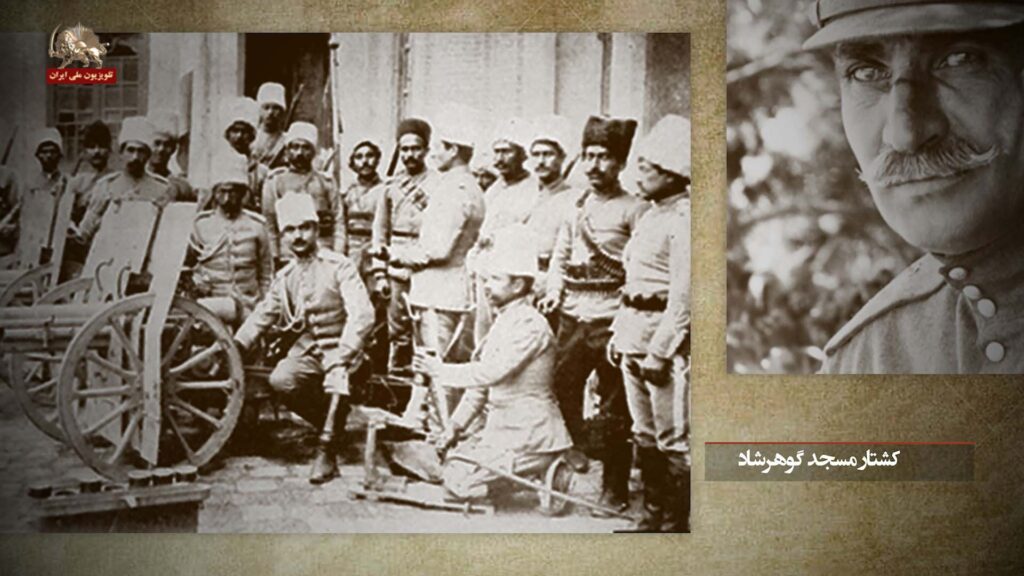
Iran: The Goharshad Mosque Massacre in Mashhad
Ordered by Reza Shah The massacre at Goharshad Mosque in Mashhad on July 14, 1935, stands as one of the darkest acts of the Pahlavi monarchical tyranny. The conflict erupted over the forced imposition of Western-style clothing and hats, a policy presented under the guise of modernization but entirely devoid of any political freedom. The tensions that culminated in the massacre began to build in mid-July 1935. On July 10th, authorities began arresting protesters and public speakers. On the evening of July 12th, the order for a military assault was issued. With a battle bugle call, Reza Khan’s army forces attacked protesters who had staged a sit-in at the Goharshad Mosque—the epicenter of the dissent—leaving many killed and wounded. On July 14, 1935, Reza Shah massacred countless souls at Goharshad Mosque for protesting a forced dress code. The crime wasn't just the violence, but the principle: a dictator imposing his will on the people. #No2ShahNo2Mullahs #FreeIran2025 pic.twitter.com/YtjMM9OO87 — SIMAY AZADI TV (@en_simayazadi) July 12, 2025 The slaughter peaked on July 14th. Reza Khan’s forces set up machine guns in the archways of the Goharshad Mosque and positioned artillery on Tehran Street in Mashhad, directly opposite the shrine complex. They continued their assault, killing a great number of people. The bodies of the victims were later buried in mass graves in Mashhad. This event was rooted in the geopolitical shifts of the era. Following the fall of the Tsarist monarchy in Russia and the 1917 October Revolution at the end of World War I, British colonialism sought to build a buffer to protect its Asian colonies, particularly India. To achieve this, Britain orchestrated the rise of Reza Khan, a Cossack officer who had previously been aligned with Tsarist Russia. Through a 1921 colonial coup directed by the British General Edmund Ironside (Commander of British Forces in Iran), Reza Khan was brought to power, and by 1925, he was installed on the throne. Fourteen years after the coup of February 22, 1921, Reza Shah traveled to Turkey in 1935. Upon his return, he issued a directive forcibly banning the hijab for women and mandating the European-style fedora (Shapo) for men. (Source: A Twenty-Year History by Hossein Makki, p. 144 onwards). A Twenty-Year History by Hossein Makki, p. 144 Similar measures were implemented in both Iran and Afghanistan, seemingly as part of a political bloc guided by a single source: British colonialism. The British aimed to preserve the feudal infrastructure of these countries while introducing certain reforms to protect them from the wave of radical revolutions and socialist republics. A reform or prelude to ruin Iran’s economy and oppress people? This pattern repeated itself four decades later in Iran. During Mohammad Reza Shah’s so-called “White Revolution.” The Shah and his royal court pivoted from the old British colonialism, which was based on feudalism, to a dependent capitalist regime. When John F. Kennedy came to power in the United States in 1961, Iran was once again in a state of crisis, seven years after the 1953 coup against the democratic government of Dr. Mohammad Mossadegh. The Shah was forced to accept the premiership of Ali Amini, who was tasked with implementing reforms, following a teachers’ strike and uprising in May 1962. However, he dismissed Amini 14 months later and took charge of the land reform project himself, under the title of the White Revolution, to fulfill American demands. But in Reza Shah’s time, he himself was the biggest feudal lord in Iran. He left the feudal infrastructure untouched while forcibly seizing lands, especially the fertile lands of northern Iran, under the banner of royal estates. He also encouraged his army commanders to acquire property and real estate. At the same time, to maintain control, particularly in cities that were the base of the urban bourgeoisie and petit bourgeoisie, administrative and judicial reforms were necessary—on the condition that they did not lead to any political reforms related to the freedoms won during Iran’s Constitutional Revolution. The architect of these administrative and bourgeois reforms was Mohammad Ali Foroughi, a veteran British agent who served as Reza Shah’s Prime Minister and advanced his agenda with his British-aligned team. Foroughi was the same man who played a key role, in coordination with the British embassy, in the exile of Reza Khan from Iran in August 1941 and the installation of Mohammad Reza Shah. While Reza Shah accepted the administrative and bourgeois reforms demanded by Britain due to the pressures of the time, political freedom remained an uncrossable red line for his tyranny throughout his reign. For this reason, the foundations of feudalism also remained intact. Similarly, various nationalities, from our Arab compatriots in Khuzestan to those in Baluchistan, Kurdistan, and Lorestan, were subjected to the most severe repression. Meanwhile, the D’Arcy Oil Concession (a petroleum exploration agreement that gave Britain exclusive rights to Iranian oil) was extended in 1933 for another 30 years in favor of British colonialism, accompanied by a great deal of propaganda and fanfare. D’Arcy Oil Concession Had reaction and colonialism not stood in the way of Iran’s Constitutional Revolution and suppressed it, it is clear that the revolution, in the course of its development, would have dismantled the system of large landownership and the feudal regime. But Reza Khan carried out his mission with absolute dictatorship and widespread massacres. The massacre at Goharshad Mosque over the forced imposition of Western clothing and hats, a policy devoid of any political freedom, was one of the products of this dark royal tyranny. What is interesting is that Asadi, the custodian of the Astan-e Quds Razavi (the foundation managing the Imam Reza shrine and Iran’s largest Islamic financial endowment or Moqofati), was opposed to this repression at the time. As a result, he was dismissed and later executed on the Shah’s orders. Reza Khan’s military apparatus blamed Asadi for the turmoil and riots. Another noteworthy point is the position of Ruhollah Khomeini, founder of the current clerical regime, during the massacre. Khomeini, who claimed the status of ijtihad (the authority to