Simay Azadi English

Author name: Amir Pasha Borjkhani

Exclusive Interviews, News

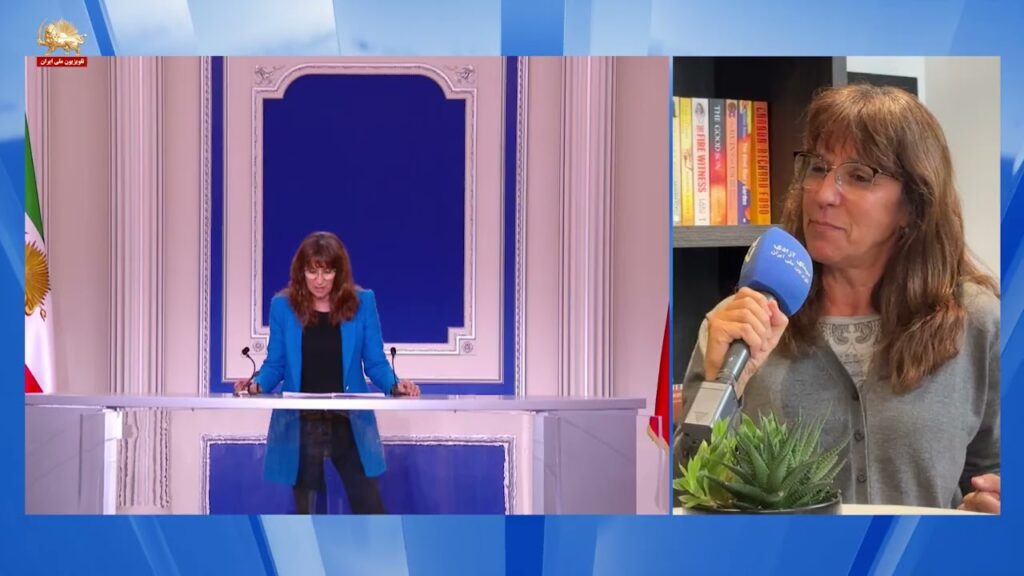
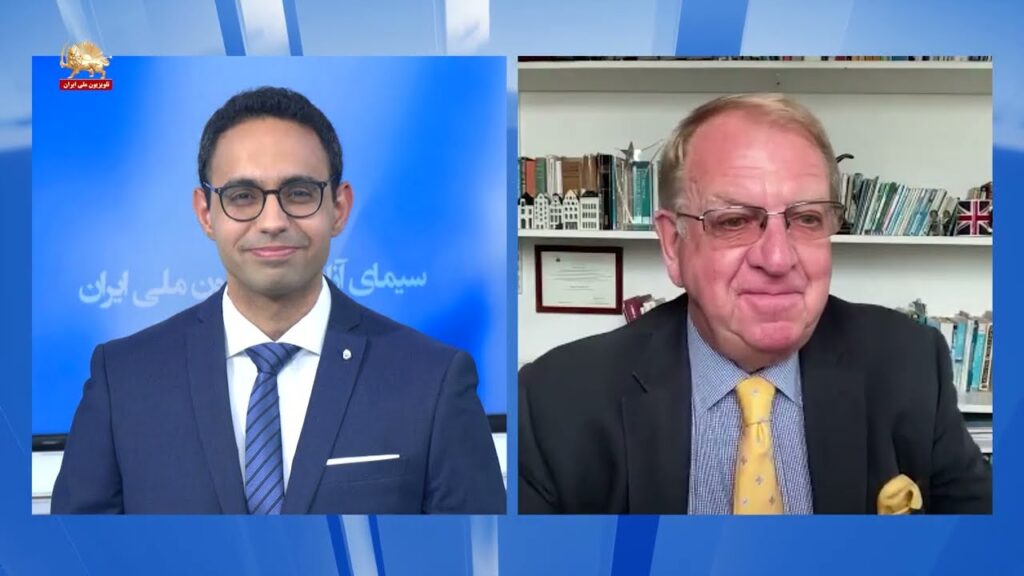
Insights on Iran’s Future: An Interview with Mr. Stevenson

An interview with Mr. Stevenson on Iran’s political landscape and the need for democratic change.


[TEXT]:
Welcome, Mr. Stevenson, and thank you for accepting our invitation for this interview with Seemai Azadi.

It’s a pleasure. It’s always a pleasure to speak to you.

So let’s start with the questions. You were one of the speakers at the recent event in the UK Parliament that brought together lawmakers from both houses to discuss developments in Iran and a possible path forward. Could you tell us, please, about the focus of that meeting, how it was received, and how you view its significance at this time?

The meeting was arranged by the British Committee for Iran Freedom. Now, I’ve been to many meetings arranged by that important organization. This meeting was in the House of Lords and was attended by more than 30 MPs and peers from the House of Lords. It was one of the biggest, best-attended meetings I’ve ever been at. The reason was the Committee for Iran Freedom; they were billing the meeting as looking at a third option for the future of Iran. Everybody knows now that we have reached the tipping point with the Mullah’s regime. The dictatorship is on the edge of a cliff. It’s about to tumble over into the abyss. After the 12-day conflict involving both Israel and America, and after the effective decapitation of the so-called axis of resistance that the mullahs always relied on, we have seen the mullahs now at the weakest point they have been since the 1979 Revolution. They have reached the tipping point. This has become of critical importance to the rest of the world because everybody recognizes that the dictatorship in Iran is the head of the snake. We have now reached this ceasefire, which is a fragile ceasefire between Iran, Israel, and America.

But we now can see that the mullahs are saying, “Oh, well, we’re going to go back to rebuilding our nuclear weapons.” It was a clandestine affair for many years, exposed by the recent top-level report to the UN Security Council by the UN nuclear watchdog, the International Atomic Energy Agency, and its boss, Rafael Grossi, who said, “The Iranians now have £900 worth of heavily enriched uranium, enriched to almost weapons-grade, 60% purity.” They could produce a number of nuclear bombs in a very rapid time. Clearly, the time has arrived for the world to take notice of this, to stop messing around with appeasement and dialogue and all the rest of it. This was the purpose of the meeting in the House of Lords. We were looking at the three options that have always been traditionally tabled. The three options include military intervention, which, of course, nobody wants. No one wants to see boots on the ground, which would effectively lead to an Iraq-style situation. The second option has traditionally been appeasement. For far too long, the EU, in some cases under the previous Biden administration and the UK, have said, “Oh, but we must try to talk to the moderates in the leadership of the mullahs’ dictatorship.”

This has never worked. Appeasement can lead to war. That’s the lesson we should have learned from history. And appeasement, certainly with the mullahs, has made no difference at all. They love to play for time and to pretend that they’re willing to negotiate. No negotiations ever take place. They take hostages. They say, “If you give us more freedom, if you lift more sanctions, we will return your hostages.” When we capitulate and give them what they ask for, they simply take more hostages again. So negotiation has come to an end. What we must look at is the third option. The third option is quite clearly backing the Iranian people and their democratic opposition and the resistance movement to overthrow this tyrannical regime and to restore peace, democracy, human rights, and women’s rights, end the death penalty, end the nuclear threat, and restore peace not only to the Middle East but to the whole world. That was the message coming across in the House of Lords meeting, and that was the message that the MPs and peers who attended were prepared to take back and to talk to ministers, to talk to the UK government, to try to implement these ideas.

You just spoke about the third option. Could you please elaborate on that? What are the core values of this option and how can it be realized by the Iranian people and their organized resistance, as you referred to?

Well, nobody wants to see boots on the ground. Nobody wants to see military intervention that would lead to a huge conflict and reduce Iran to what happened in Iraq. That is a lesson from history that we want to avoid. We also have to wake up to the fact that appeasement just doesn’t work. Those people who keep saying, “Oh, but we’re searching for a moderate within the leadership of the Iranian mullahs’ regime,” there is no such thing as a moderate. They said when Massoud Pzezkian was elected with a tiny proportion, the tiniest proportion ever of the common vote in the whole of Iran, when he was elected after Abraham Raisi’s death in the helicopter crash, everybody said, “He is a moderate figure. He is a heart surgeon. He is the person we could talk to.” Since his election, there has been a frenzy of executions, partly because the mullahs are so frightened of another massive uprising, a nationwide uprising that could drive them from power. They’re clinging on to power by their fingernails. They have authorized a frenzy of executions that’s leading to hangings; virtually five or six people are being executed every day.

The regime is waging war on its own people. Now, that’s why there has been a huge rise in the resistance movements, which are commanded by the National Council of Resistance of Iran and the Mujahideen-e Khalq, the MEK, and people in the West have to wake up to the fact that we need to show the Iranian resistance and the Iranian people that we back them morally; we support them. They have a right to overthrow this evil regime. They have a right to introduce the 10-point plan that Mrs. Maryam Rajavi, the charismatic leader of the National Council of Resistance of Iran, has proposed, which would restore peace, democracy, human rights, women’s rights, and end the death penalty and the nuclear threat. This is what the people of Iran want, and this is why the West has an imperative now at this tipping point in the numbered days of the mullahs’ regime. We have the opportunity now to push them over the edge and to give moral support to the people of Iran and their resistance to do this.

Thank you very much. So for our third question, you’ve been the author of several publications and books, but one of your most recent publications is a book called “Dictatorship and Revolution: Iran: A Contemporary History,” which traces more than a century of political developments in Iran, including the monarchy, Pahlavi’s regime, and the post-1979 system. It also discusses how different political currents have shaped the country’s direction. In that context, how do you assess the recent efforts by the remnants of the Shah’s regime to reenter the political landscape, including the reported outreach to parts of the IRGC? Do you see these efforts as part of a broader trend? And what perspective does your book offer in understanding how past systems of governance continue to influence the present debate about Iran’s future?

Well, when the people of Iran rose up in 1979 to overthrow the Shah, it was because the Shah was a hated figure; he had demolished democracy. He had gotten rid of all political parties except one, his own political party. His secret police, SAVAK, were well known for their brutality, for torturing, for tearing out fingernails and toenails to extract false confessions before people were then executed. This was a hated regime that the people of Iran rose up and overthrew. Sadly, the revolution was hijacked by Khomeini, who the world, again, stupidly thought, “Oh, he is a holy man. He is a religious leader. He must be a moderate. He will restore peace and justice to the people of Iran.” He was clearly a psychopath, as we discovered, with his fatwa against the MEK, which led to the execution of more than 30,000 political prisoners in the massacre of 1988—a horrific event that is still under close examination by the United Nations. But every time we have seen the signs of a nationwide uprising, and there have been quite a few recently, particularly the massive uprising after the death in custody of Mahsa Amini, when we saw millions of people take to the streets, every time there is an uprising, and it looks like there could be an opportunity to overthrow the mullahs, up pops the son of the Shah, Reza Pahlavi.

He has done absolutely nothing for 46 years. He has lived in luxury in his hugely affluent houses and palaces that he has all over the world, based on the estimated 25 to 30 billion dollars that his father looted from the people of Iran. The Pahlavi family is living in affluence and luxury, but he suddenly pops up and starts jetting around the world claiming he is the Crown Prince, saying he will be the savior of Iran after the mullahs are overthrown. He will come back and claim the Peacock throne. This is pathetic nonsense, quite frankly, for a man who has no credibility whatsoever and no support within Iran. During these protests, people are chanting, “No to the Crown, no to the turban.” They say, “No to the Shah, no to the mullahs.” He has no credibility. Worse still, recently, he has totally misread the situation. When Israel was attacking Iran directly during the 12-day conflict, he misread that situation by saying, virtually, that he supported Israel and calling on the people of Iran, “Now is your moment, rise up and overthrow the mullahs while the Israelis are attacking.” The Israelis were actually, some of their missiles and bombs were killing Iranian citizens.

For somebody who claims that he wants to be the king of Iran after the overthrow of the mullahs to say, “I am backing the Israelis for attacking us right now,” was a seriously damaging mistake, which shows his lack of imagination. Also, incredibly, he held a press conference in Paris last month in June, where he said he is in direct communication with leaders in the IRGC, the Islamic Revolutionary Guards. He says that he is inviting them because they want to be part of the national salvation. He’s inviting them to join him when they overthrow the mullahs. This sounds like, at the end of the Second World War, Winston Churchill saying, “We will need the help of the Gestapo to maintain peace after we get rid of Hitler’s Nazis.” This is just stupidity and incredible. He really has made himself into a joke figure. He’s the son of the naked Emperor trailing around Europe—the Emperor with no clothes—or indeed, the Clown Prince would be a more appropriate characterization.

So thank you very much for this enlightening answer. Let me ask you at the end of this interview about your message to the Iranian people, because you are one of the long-lasting supporters of this resistance. If you have any message for the Iranian people, please tell them right now.

Well, I’ve spent the last roundabout quarter of a century supporting Mrs. Rajavi and the Iranian resistance, the National Council of Resistance of Iran. I know that these people are like a government in exile. They have a perfect plan. They are saying it will be up to the Iranian people to produce a new constitution to elect the government that they want to lead them. But in the meantime, we’ve got to support them. We have to rely on the Iranian people themselves to rise up and do this, to back their resistance movement, these courageous people who are taking to the streets day and night to try to overthrow the current tyrannical regime. The West has to back them. The message for the West now is to ban the IRGC, blacklist the IRGC and the Basij, and introduce the snapback mechanism through the United Nations that reintroduces all of the sanctions that were put on hold. The regime is at its last legs. We now need to give it that final push over the edge of the cliff.

Well, thank you very much for accepting this interview with Seemai Azadi. It was indeed a pleasure to have you with us.

It’s been a pleasure, as always, to speak to you.

Thank you.

Exclusive Interviews, News

Simay Azadi’s Interview with Ambassador Stephen J. Rapp on Iran’s Situation

Simay Azadi’s Interview with Ambassador Stephen J. Rapp on Iran’s Situation On July 31, 2025, just before the Free Iran Summit in Rome, I spoke with Ambassador Stephen J. Rapp, 4th United States Ambassador-at-Large for War Crimes Issues who has long campaigned for justice for victims of political repression. Ambassador Rapp is among more than 300 international figures who signed a recent statement urging urgent action to stop the execution of Iranian political prisoners. In this interview, he spoke about the recent execution of two People’s Mojahedin Organization of Iran (PMOI/MEK) supporters, Behrouz Ehsani and Mehdi Hassani, the 1988 massacre, the need for international accountability, and his strong support for the President-elect of the National Council of Resistance of Iran (NCRI), Mrs. Maryam Rajavi’s Ten-Point Plan for a democratic Iran. Question: Thank you very much, Mr. Ambassador, for accepting this interview with Simay Azadi. Recently, two political prisoners, PMOI supporters Behrouz Ehsani and Mehdi Hassani, were executed. And at least 14 other PMOI supporters are on death row. You are among over 300 personalities who signed a statement urging the international community to stop their execution, and you later condemned these executions. Can you elaborate about this situation? Ambassador Rapp: Well, what we see in Iran these days is almost massacres in plain sight. Using this judicial system—five-minute trials behind closed doors, false evidence, charges like “enemy of God” or terms that don’t mean anything in terms of people’s actual conduct or criminal conduct—resulting in executions. The UN rapporteur said we may see the largest number this year since the horrendous 30,000 executions that occurred back in 1988. Clearly, this regime is using the threat of death through these processes to intimidate and to try to silence the opposition. They’re not going after even their foreign enemies. They’re going after the domestic opposition—the people that would be elected if Iran was a democracy. It’s absolutely essential that the international community speaks strongly, but goes beyond words to effective action, to show that there will be accountability for these crimes and that the prospect of justice for the survivors of these victims won’t be swept under the carpet. There must be the expectation that those responsible for these mass murders are held to account. Question: You mentioned the 1988 massacre. We had, was the landmark report by Professor Javaid Rehman about this massacre, and he specifically underlined that these crimes against PMOI supporters back in the 1980s amount to crimes against humanity and genocide. As an expert, what is your opinion about this report? And what should the international community have done since this report was published? Question: Well, it’s essential to hold the people responsible for those crimes to account. Obviously, we had people like President Raisi, who led those executions, who is no longer with us. But there are thousands of others who have moved into positions in this regime that are responsible for those crimes, and some who may be abroad, and some who may have assets abroad. They need to be held accountable. The professor is clear: these are international crimes. In many countries of the world, crimes can be prosecuted even if they’re not committed in those countries, if they are international crimes—even for crimes committed in 1988, because they were international crimes at that time. What we’ve done in other situations—for instance in Syria—we had a regime under Assad strongly supported by Iran and its militia Hezbollah. One reason that a vicious dictator was able to stay in power so long, to kill half a million of his own people, destroy half the country, drive off half the population, and engage in mass murder, mass disappearance, torture, and use of chemical weapons, was because of that support. Even while that regime lasted—and of course we know it fell thanks to the Syrian people themselves last December—we were able to hold some of his torturers to account in courtrooms in Germany, in France, in Scandinavia, and other cases are pending around the world, even one against Assad himself. Now we have a chance for justice in Syria by the Syrian people, and I strongly support that. But you can begin cases like that and you can prosecute them. It’s very important that countries assist each other and also resist the kind of pressure, for instance, that Sweden faced when it was forced to give up one of those executioners it convicted. That’s the kind of resolution it takes if we’re going to achieve justice in this situation and send a clear message to the leaders of Iran that if they commit these kinds of crimes again, they will not have a day of rest in this life. Question:  You just mentioned that the regime has ramped up suppression since the end of the12-day war. How do you perceive that, and can you elaborate, because you have written about the regime’s recent rampant executions? Ambassador Rapp: Well, clearly the regime is using its own weakness not to go after its external enemies but rather to turn its attention on people who support a free Iran. Those are the people it is vulnerable to. The possibility of external intervention would be a disaster for Iran; it is the people of Iran who need to make the change. As we’ve seen in the demonstrations of 2019 and 2022, and in the government’s failure to even run the electricity and provide necessities to its population, there’s enormous opposition to it. That’s what the regime fears. It uses foreign enemies as an excuse to go after people who have nothing to do with those enemies, who support Iran and want democracy. Change is always possible. It’s happened in many countries. Regimes seem permanent until they’re not. Sometimes even people within the regime realize it’s not serving the country. The only permanent regime change that serves the people’s interests is when they do it themselves. External intervention, as we’ve seen, has enormous negative consequences and often allows bad regimes to wrap

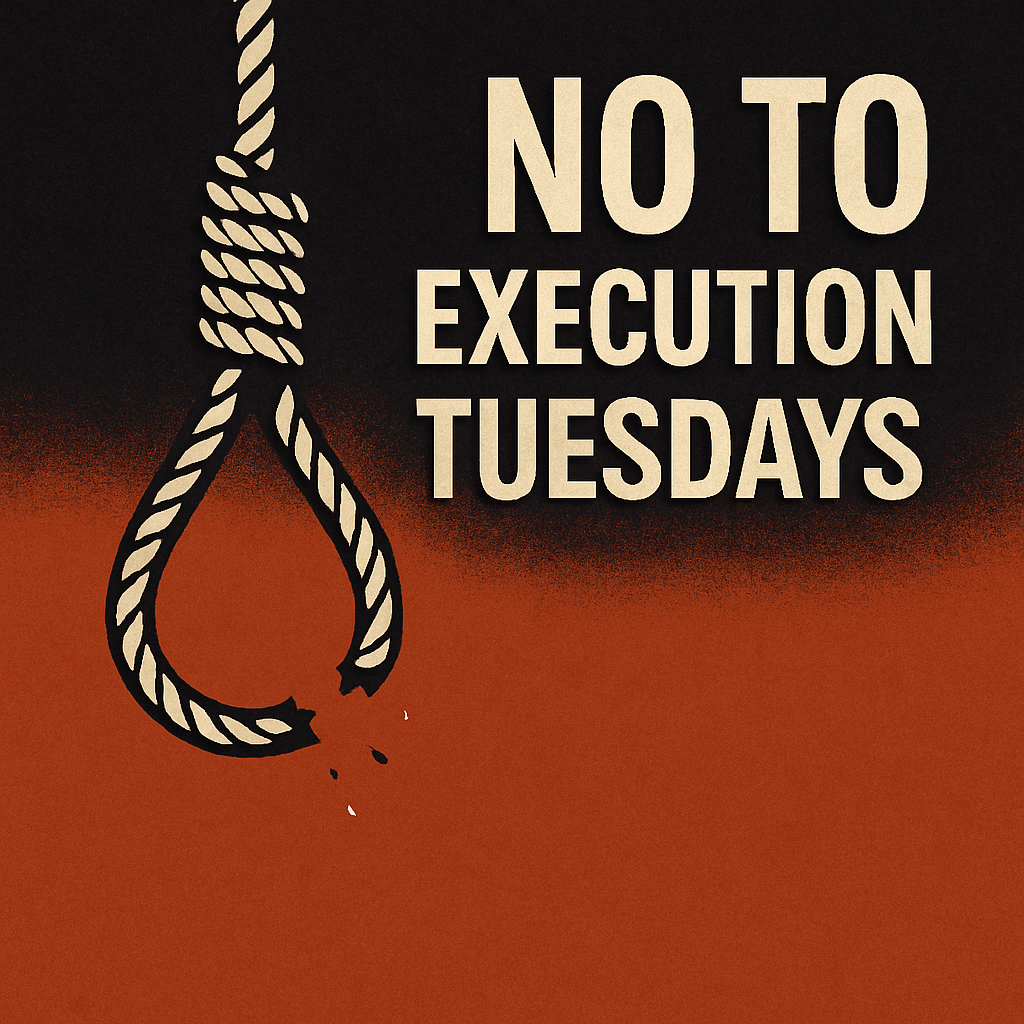
No to Execution Tuesdays Week 78
News, Special Production

Iran 78th Week of “No to Execution Tuesdays”

The “No to Execution Tuesdays” campaign underlines that Iran’s regime Executes 71 in one month amid crackdown on political prisoners July 22, 2025 – In the 78th week of the “No to Execution Tuesdays” campaign, prisoners in 48 prisons across Iran launched coordinated hunger strikes to protest the genocidal regime’s use of the death penalty and escalating repression against political prisoners. Since June 21, Iranian authorities have executed at least 71 individuals. The campaign emphasized that these executions were carried out without fair trials and often relied on forced confessions extracted under duress. “These are not acts of justice—they are acts of terror,” the No to Execution Tuesdays campaign declared in its statement. The surge in executions has been accompanied by intensified persecution of the campaign’s own imprisoned members. Reports from inside prisons detail mounting threats, physical and psychological torture, arbitrary exile to distant facilities, and the harassment and detention of family members. Political prisoners have also been systematically denied basic legal and medical rights. “This systemic repression is part of the regime’s unrelenting attempt to silence a society that, despite all pressure, continues to insist on its right to justice, freedom, human dignity, and self-determination,” the No to Execution Tuesdays campaign stated. This week’s statement reaffirms the campaign’s condemnation of capital punishment and its continued resistance against the regime’s use of execution as a tool of fear. “We wholeheartedly condemn this violent, inhumane, and unjust campaign of executions and repression. Execution is not a path to justice—it is a tool of terror. No state should have the right to take a human life, especially under a judiciary that blatantly violates basic legal rights.” As the “No to Execution Tuesdays” movement enters its 78th week, it remains committed to its demand: the full and permanent abolition of the death penalty in Iran. “Our cry of ‘No to Execution’ will grow louder each week—until the day executions are abolished in Iran forever.”

News, Special Production

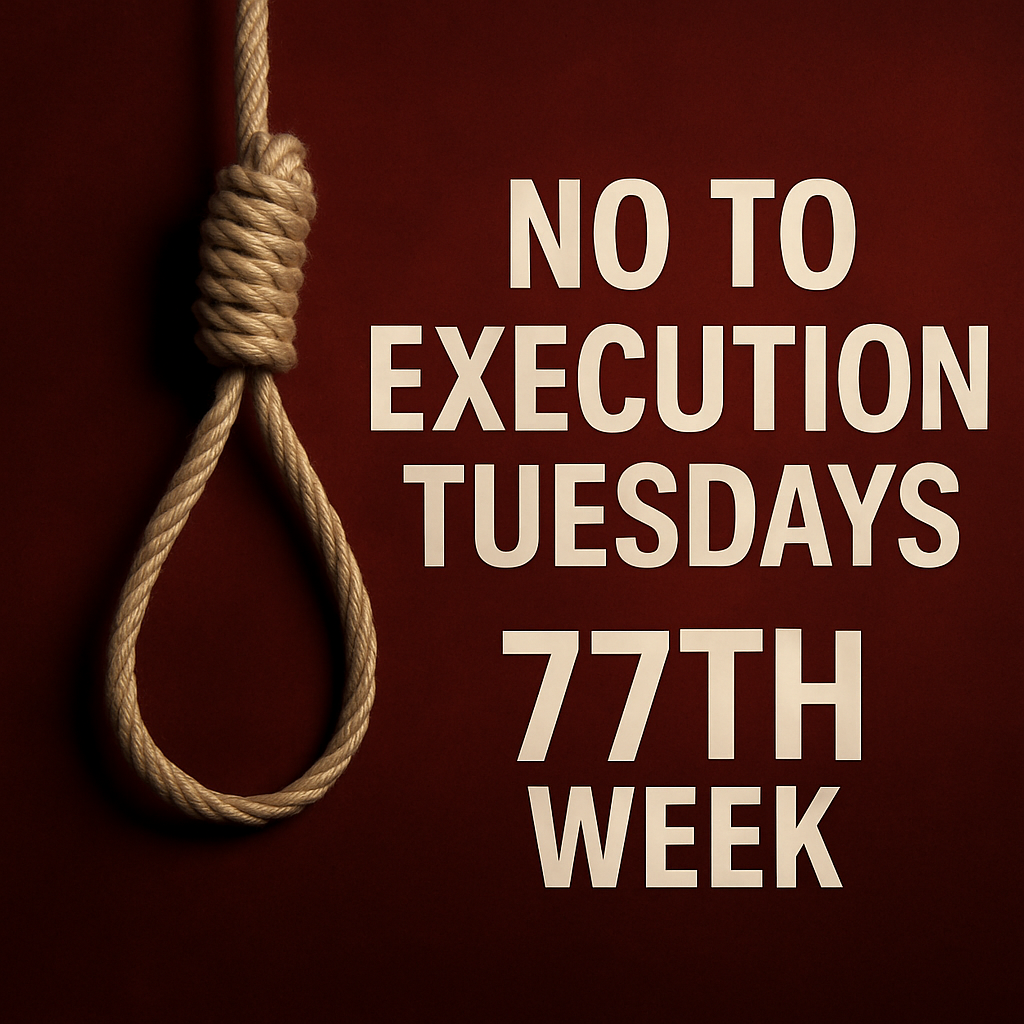
Iran: 77th Week of “No to Execution Tuesdays” – Yazd Prison Joins Campaign as Executions Escalate

July 15, 2025 – The “No to Execution Tuesdays” campaign marked its 77th consecutive week with the participation of prisoners in 48 prisons, including newly-joined Yazd Prison. This ongoing coordinated hunger strike challenges the genocidal regime’s escalating use of executions as a tool of control and repression. In their weekly statement, the campaign reported:“This is the voice of resistance from within the prisons of the Supreme Leader’s system—against executions and state-sponsored killing.” International concern continues to grow. Ms. Mai Sato, UN Special Rapporteur on the situation of human rights in Iran, raised alarms over the fate of three Arab political prisoners—Ali Mojadam, Moein Khanfari, and Mohammadreza Moghaddam—who were recently moved to solitary confinement in Ahvaz and face imminent execution. Their families have received no updates, raising fears of enforced disappearance, a method of state terror frequently used by the regime. Meanwhile, the Ahvaz Revolutionary Court issued two death sentences each for Farshad Etemadi-Far, Masoud Jamei, and Alireza Mardasi, all political prisoners. Separately, retrial requests were rejected for the fourth time for Mehdi Hassani and Behrouz Ehsani, whose cases are marred by serious legal inconsistencies. Authorities continue to deny their lawyers access to case files, citing secrecy—an illegal obstruction widely practiced in political trials. The campaign also reported a sharp increase in executions:At least 44 people have been executed since June 21, including one woman. Two of these executions were carried out in public, in Miandoab and Bukan. The statement emphasized:“This is only the documented number. Every day, on average, two people are being hanged in this regime’s death factories.” The addition of Yazd Prison reflects the growing reach and determination of the campaign, even under intensified crackdowns. The statement affirmed:“This expansion shows the people’s awakening and determination to resist the medieval machinery of death.” Despite heightened threats, the families of the condemned continue to participate in weekly protests. The campaign called on the public to actively confront these state spectacles of fear:“Freedom-loving Iranians must transform these stages of execution into stages of resistance and exposure.” In closing, the campaign urged collective solidarity:“Do not leave these families alone. Our power lies in our unity—and we will sweep away this regime’s apparatus of execution.”

Exclusive Interviews, International Gatherings, News

Conference At the European Parliament: The Real War in Iran and Its Solution  

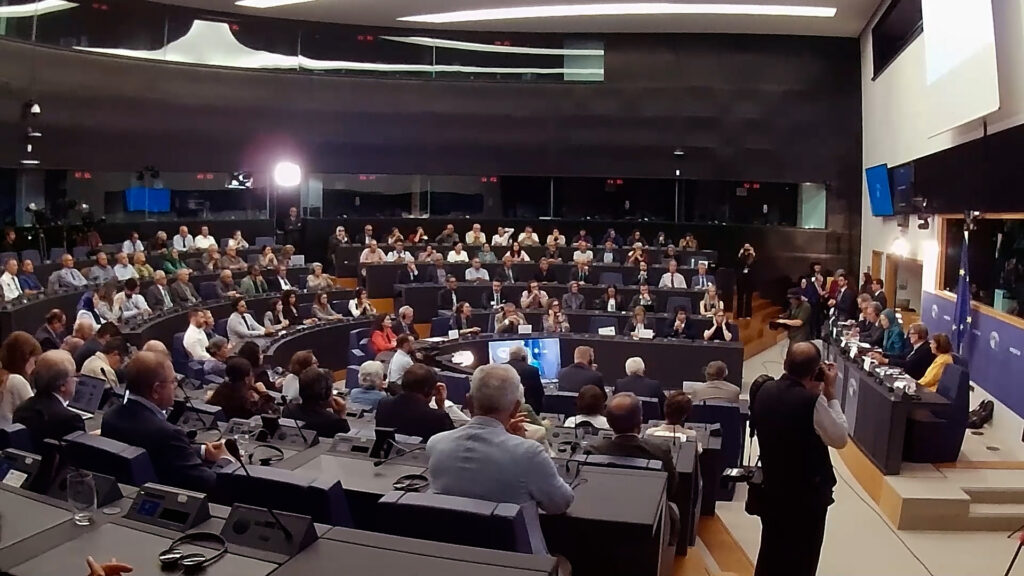
By Amir Pasha Borjkhani On June 13, 2025, war erupted between Israel and the Iranian regime. While many analysts speculated about the conflict, the true struggle soon became undeniable: Iran people’s enduring battle against the ruling theocratic regime, led by their organized Resistance. This was the central focus of two significant conferences held at the European Parliament on June 18. My colleagues and I were also in Strasbourg to cover this event.  There, Mrs. Maryam Rajavi, president-elect of the National Council of Resistance of Iran (NCRI), spoke alongside MEPs such as Javier Zarzalejos, Antonio López-Istúriz White, Petras Auštrevičius, and Pekka Toveri as well as distinguished European figures including Guy Verhofstadt, former Belgian Prime Minister and MEP, Enda Kenny, and former Prime Minister of Ireland. Their speeches shed light on Iran’s escalating crisis. Mrs. Rajavi, the keynote speaker, delivered a captivating and insightful address. She declared that the “crisis of overthrow has now engulfed the entire clerical dictatorship” and described the war as “the beginning of a critical new chapter—both in Iran’s internal crisis and in the broader dynamics of the region.” Yet, she emphasized that the core conflict, spanning 44 years since June 20, 1981, remains the Iranian people’s struggle against the theocratic regime. For decades, the NCRI, led by Mrs. Rajavi, has championed the “Third Option”: regime change driven by the Iranian people, rejecting both war and appeasement. Recalling her 2004 address to the European Parliament, Rajavi reminded the audience of her warning that “the policy of appeasement encourages the clerical regime to persist in its policies and, ultimately, imposes war upon Western nations.” Setting the record straight, she stated, “From the outset, our Resistance made it clear: a viper never gives birth to a dove, and a religious dictatorship is inherently incapable of reform.” Instead of requesting material support, Mrs. Rajavi appealed to the MEPs: “We do not seek money, nor do we ask for weapons. What we have always wanted is to resist—just as Europeans once did—against theocratic tyranny. We only ask that this Resistance be recognized. Nothing more.” She criticized the international community for denying the Iranian people and their Resistance “this most basic right.” European speakers amplified Rajavi’s call for the Third Option, emphasizing the Iranian people’s role in achieving regime change. “The regime in Tehran has managed for years to deceive those who viewed it as a potential partner for stability in the Middle East. It has always been the temptation to exchange democracy and freedom for stability,” said MEP Zarzalejos, who presided the first conference in this regard. “In the end, you get no stability and you get no democracy. Today, we must face reality. The time for illusions is over. The threats posed by this regime can no longer be deferred. And this is why Mrs. Rajavi’s vision is important,” he added. MEP Antonio López-Istúriz White praised the NCRI’s democratic vision, saying, “Madam Rajavi, you noted the council will dissolve once Iran’s elected assembly is formed. Few organizations make such a promise. That gives reassurance.” MEP Petras Auštrevičius highlighted Mrs. Rajavi’s proactive role, stating, “Madam Rajavi’s 10-point plan proves you shape Iran’s events, not just follow them. This upheaval could lead to regime change and a democratic future.” MEP Pekka Toveri urged EU support, declaring, “Iranians lead their future, but the EU has means and must find the will to act. A democratic Iran ensures our safety.” In an interview afterward, he elaborated, “There was a lot of discussion and very strong support from EU parliament members to continue support to Iran. We know that the fight is not in the end. This is probably the beginning of the end, but we have a good chance to create a free, democratic Iran.” Former Prime Minister Enda Kenny commended Mrs. Rajavi’s self-reliance, noting, “Madam Rajavi, you want Iran’s people to overthrow the regime, not foreign entities. This parliament must offer coherence and understanding.” In a post-conference interview with Simay Azadi, he reinforced this, saying, “The solution to the problem in Iran lies with the Iranian people. It’s been made perfectly clear that there is no wish to have an outside change imposed upon Iran, nor is there a seeking of financial assistance to bring this about. It will happen, as happened in every case since the overthrow of Marcos in the Philippines so many years ago.” Guy Verhofstadt linked democracy to security, asserting, “A democratic Iran prevents a nuclear threat. We must recognize the NCRI as the Iranian people’s true representative.” In an interview following the event, he stressed, “Western leaders, American and European, can do a lot now in this existential moment for the Iranian people. And that is to recognize the democratic opposition as the only legal representative of Iran and the Iranian people. That would give enormous courage to the Iranian people because they will know that there is a future without the mullah regime.” As I left the conferences, I couldn’t shake the weight of what I’d heard. Mrs. Rajavi’s vision, echoed by these European leaders, painted a path forward driven by the Iranian people themselves. Their words lingered, leaving me to wonder how the world might respond to this call for change.

Simay Azadi TV Interview with Helen Carreiras
Uncategorized

Helene Carreiras to Simay Azadi: Iranian Women Empower the Global Fight for Justice

In an interview with Simay Azadi, Helene Carreiras, Portugal’s first female Minister of Defense (2022-2024), shared her powerful reflections on the “Women, Force for Change – Free Iran 2025” conference, held by the National Council of Resistance of Iran (NCRI) in Paris on February 22, 2025. The event, a prelude to International Women’s Day 2025, which brought global leaders together to honor Iranian women’s resistance against Tehran’s regime and rally support for their democratic vision. The conference had the NCRI President-elect Maryam Rajavi as the keynote speaker who explained her Ten-Point Plan for a secular, democratic Iran, endorsed by over 650 women leaders from 80 countries, including Ms. Carreiras. They condemned Iran’s systemic discrimination and called for the IRGC’s terrorist designation, hailing Iranian women as a global inspiration. I asked Ms. Carreiras how she assesses the role of women in the Iranian resistance and their situation in Iran. She replied, “We know from research that nations who fail women ultimately fail as well. The situation of women tells us a lot about the ability of a society to develop and give their citizens the basic rights to thrive. Women have been victims in many situations, and the case of Iran is particularly relevant because they’ve been so active, so protagonists in this fight. Their visibility is a force for change, really.” I then asked about the conference’s message and her feelings participating. “It was emotional for me because I could sense the determination, the courage, the cohesion behind this movement,” she said. “The courage, the determination of these women is an inspiration for us all. It also empowers us to fight the same fight we have in our own countries, because this is a fight about democracy, human rights, it’s a fight for justice. Iranian women are not alone fighting against tyranny, against a regime that has been depriving citizens of Iran—and women in particular—of the very basic rights they should be entitled to.” Carreiras closed with a heartfelt message to the Iranian women: “Thank you so much for what you’re doing, because you’re strong and we’ll be stronger together.”

Iran Women Conference Simay Azadi
Maryam Rajavi, News

Global Leaders in France Spotlight Iran Women’s Fight at IWD 2025 Conference

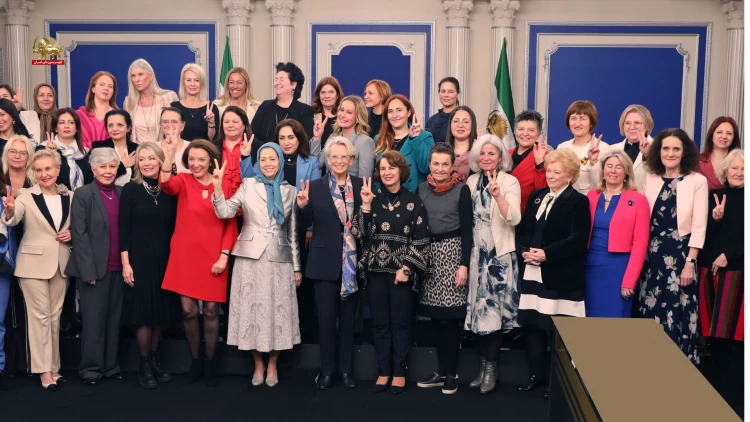
On February 22, 2025,  A major conference convened today to mark International Women’s Day 2025, centering on Iranian women’s resistance against Tehran’s clerical regime. Hosted by the National Council of Resistance of Iran (NCRI), the event drew global figures, with NCRI President-elect Mrs. Maryam Rajavi delivering a keynote that galvanized calls for change. #WomenForce4Change, Free Iran 2025International Conference marking the International Women’s Day#IWD2025https://t.co/aJbQtMSpcz — Maryam Rajavi (@Maryam_Rajavi) February 22, 2025 Mrs. Rajavi told the conference, “International Women’s Day 2025 symbolizes uprising and rebellion for a world free of repression and exploitation.” She lauded Iranian women’s defiance, stating, “Over the past 40 years, they have risen time and again to say no to the misogynistic mullahs,” citing 83 women martyrs and the 1,000 women of Ashraf 3 as “inspirations to freedom-seeking girls across Iran.” Moderator Azadeh Zabeti, Chair of the Anglo-Iranian Lawyers Committee, framed the day as a push to “overcome and recognize the remaining obstacles to achieving true gender equality.” She spotlighted Iran’s women, “suffering under the misogynistic and barbaric regime of the Ayatollahs,” yet leading a “pivotal struggle for freedom.” Sarvenaz Chitsaz, NCRI Women’s Committee Chair, declared, “In the struggle against the misogynist regime ruling Iran, women are the force of change.” She linked four decades of resistance to equality, noting, “The issue of women and the equality movement has been the primary issue on the road to liberate Iran from the ruling of religious fascism.” Former French Minister Michele Alliot-Marie referred to the role of Mrs. Rajavi, saying, “You show how to do politics—it is to have a philosophy of life that brings us together toward the most beautiful word, which is peace.” She branded Iran’s regime “a threat to stability” and pressed Western governments to shift “beyond good words” to “concrete actions.” Rosalía Arteaga Serrano, ex-President of Ecuador, called Iranian women “a power of nature,” backing Mrs. Rajavi’s 10-point plan for democracy. “We say no to execution, no to exclusion,” she affirmed. Ex-Finnish PM Anneli Jäätteenmäki detailed abuses, stating, “Iranian women face discrimination in education, jobs, legal rights, and politics,” with 34 executed in 2024. Colombian ex-Senator Íngrid Betancourt proclaimed, “Love will free Iran,” commending Mrs. Rajavi: “You gave the opportunity to the women of your organization to prepare themselves for leadership,” redefining power beyond “male-dominated dynamics.” Linda Chavez, former U.S. official, predicted, “Next year, it will be Khamenei and the mullahs who flee Tehran.” She rejected monarchist nostalgia, noting a Swiss event for Reza Pahlavi drew only 200, adding, “The people of Iran want to choose their own leader.” Dominique Attias, of the European Lawyers Foundation, honored prisoner Maryam Akbari Monfared, jailed since 2009, saying, “You are the symbol of the immeasurable courage of all Iranian women.” She noted Monfared’s sentence, extended by three years in 2024 for “propaganda against the system.” Candice Bergen, ex-leader of Canada’s Conservative Party, unveiled a statement from over 650 women leaders across 80 countries, condemning Iran’s repressive laws. “Women in Iran have been at the forefront of the struggle for democracy,” she said, saluting Ashraf 3’s women as “symbols of freedom-seeking.” Mrs. Rajavi closed with a rallying cry, citing the regime’s nuclear breaches—uranium stocks “30 times higher” than allowed, per the IAEA—and urging support. “The mullahs’ overthrow is certain,” she vowed, as attendees echoed “Woman, Resistance, Freedom.”

Iran U.S Senate Conference
News

U.S. House Resolution 166 Amplifies Support for Iran’s Resistance

On February 26, 2025, House Resolution  166, a bipartisan resolution backed by over 150 lawmakers was introduced during a hearing, signaling robust support for the Iranian people’s quest for a democratic, secular, and non-nuclear Republic of Iran. Spearheaded by Representatives Tom McClintock (R-CA) and Brad Sherman (D-CA), this resolution condemns the Iranian regime’s terrorism, regional proxy wars, and internal repression while endorsing the organized resistance led by Mrs. Maryam Rajavi and the National Council of Resistance of Iran (NCRI). Unveiled during a Congressional hearing titled “The Future of Iran,” hosted by the Iran Human Rights and Democracy Caucus, the resolution and accompanying remarks from U.S. representatives underscore a strong bi-partisan support of the Iranian people’s quest for freedom and democracy. Over 150 U.S. Reps back H. Res. 166, supporting Iran’s democratic aspirations via Rajavi’s 10-point plan, condemning regime terrorism, and calling for protection of Ashraf 3 residents. #FreeIran2025@RepNancyMace @RepMcClintock @RepCohen pic.twitter.com/opolE4JwKS — SIMAY AZADI TV (@en_simayazadi) February 27, 2025 H. Res. 166: A Blueprint for Change H. Res. 166, submitted to the Committee on Foreign Affairs, explicitly condemns the Iranian regime as “a major source of terrorism and regional instability” over the past four decades. It highlights the regime’s violations of the Nuclear Non-Proliferation Treaty (NPT), its stockpile of near weapons-grade uranium, and its brutal suppression of protests—particularly those led by women and youth in 2018, 2019, and 2022. The resolution recognizes the Iranian people’s rejection of both monarchic and religious dictatorships, affirming their “inherent right to determine their political future” as per the Universal Declaration of Human Rights. The document calls for accountability through sanctions and supports Mrs. Rajavi’s Ten-Point Plan, which envisions universal suffrage, free elections, and a non-nuclear Iran. It urges the international community to recognize the rights of Iranian protesters and Resistance Units to confront the Islamic Revolutionary Guard Corps (IRGC), a key repressive force. It also emphasizes protecting Iranian political refugees in Ashraf 3, Albania, aligning with the Geneva Convention and European human rights standards. In a part, the resolution acknowledges that over 4000 “parliamentarians worldwide, including 243 bipartisan House members in Congress, the majority of 33 legislative assemblies, mostly in Europe, and over 130 former world leaders and 80 Nobel laureates have supported Mrs. Maryam Rajavi’s Ten-Point Plan for the Future of Iran that calls for universal right to vote, free elections, a market economy, and separation of religion and state, and advocates gender, religious, and ethnic equality, a foreign policy based on peaceful coexistence, peace in the Middle East, and a nonnuclear Republic of Iran.” Maryam Rajavi’s Testimony: Resistance Drives Liberation During the hearing, Mrs. Maryam Rajavi, president-elect of the NCRI, delivered a compelling case for regime change. She dismissed negotiations as futile, quoting Supreme Leader Ali Khamenei’s February 4, 2025, statement: “Negotiations are neither wise, nor intelligent, nor honorable.” Mrs. Rajavi argued that the regime has used talks to mask its nuclear pursuits and regional aggression. “The Iranian people’s desire and the only solution to the Iranian crisis is the regime’s overthrow and by the Iranian people,” she declared, stressing the necessity of an organized resistance over mere sanctions. Mrs. Rajavi referred to the struggle of the People’s Mojahedin Organization of Iran (PMOI/MEK) and its Resistance Units, where “women play a pioneering role,” as Iran’s freedom fighters. She outlined the NCRI’s transition plan: a provisional government post-overthrow, lasting six months, to oversee free elections for a Constituent Assembly. “We are not seeking to seize power, but to transfer it to its rightful owners, namely, the people of Iran and their votes,” she affirmed, reinforcing her vision for a secular, democratic republic. Lawmakers’ Voices: A Unified Call for Action Representative Tom McClintock set an optimistic tone: “We can all sense that the tide is turning. The Iranian regime has become a pariah among the civilised nations of the world and a supreme source of misery, injustice and oppression for its own people… It’s not inconceivable to me that within the next few years we will be celebrating the liberation of Iran.” Brad Sherman praised Mrs. Rajavi’s leadership: “I’m honored to be with Maryam Rajavi, the president-elect of the National Council of Resistance in Iran. This blood-thirsty regime occupying Tehran is a threat not only to all the people in Iran, but to the region and the world… I’ve been working with you for 28 years. And I say I’m going to work with you for another 28 years. But we’re going to get this done much, much sooner than that.” Zoe Lofgren (D-CA) lauded Mrs. Rajavi’s “tremendous leadership in this fight for freedom in Iran,” adding, “The examples of the heroism of the Iranian people, especially the women and young people, inspire us… The Iranian government’s reaction to these peaceful protesters of violence and the force is abominable and something we all oppose.” Mario Díaz-Balart (R-FL) called Mrs. Rajavi “one of those people that inspires us all,” asserting, “The cause of a free Iran is, well, it’s living, it’s active, and it will succeed… A change in regime in Iran is a service to humanity, and we should not be shy about expressing that openly.” Danny Davis (D-IL) said, “Every time I hear you, I am inspired. I’m what is called an activist all of my adult life.” Keith Self (R-TX) hailed her as a “courageous articulate leader,” warning, “When the regime feels threatened, their survival will be paramount.” Randy Weber (R-TX) urged action: “Iran is on its back heels… Now is the time, right? Come on, now is the time we strike.” Lance Gooden (R-TX) affirmed, “Mrs. Rajavi[’s] Ten-Point Plan is something that we have all been very supportive of for so many years… The American people stand with you.” A Firm Policy Takes Shape Mrs. Rajavi proposed concrete steps: activating the UN snapback mechanism, placing Iran under Chapter VII for threatening global peace, and recognizing the resistance’s fight against the IRGC. H. Res. 166 echoes these, condemning the regime’s atrocities—like the 1988 massacre of up to 30,000 political prisoners, mostly

Legaret to Simay Azadi
News

Jean-François Legaret To Simay Azadi : We Must Stand With NCRI Until Victory

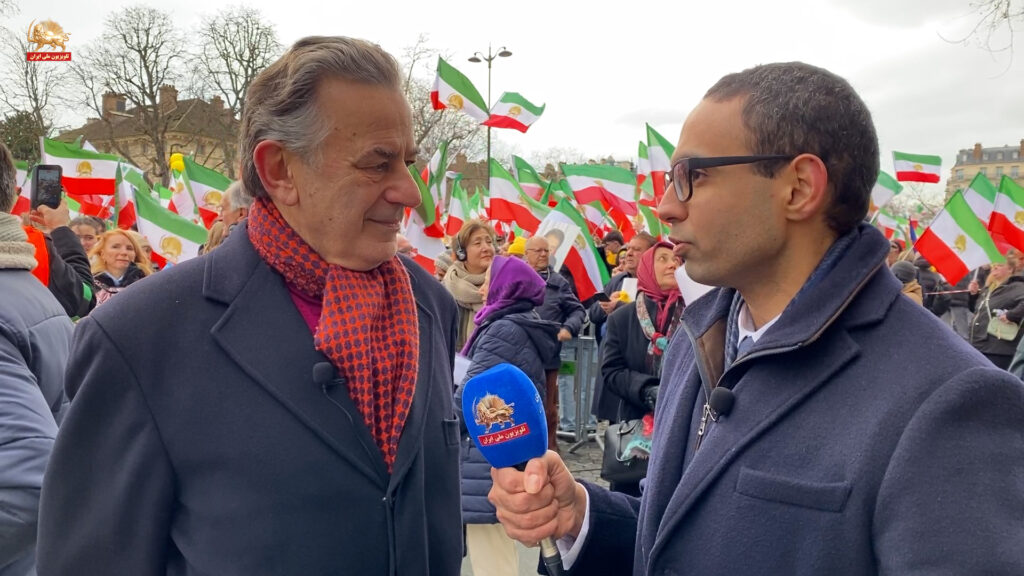
Paris, February 8, 2025 – Thousands of Iranians and supporters of the Iranian Resistance gathered in Paris to mark the anniversary of the 1979 revolution, demanding an end to dictatorship in Iran. The event, a powerful show of defiance against the ruling theocracy, underscored the growing momentum for democratic change. Among the speakers at the rally was Jean-François Legaret, former mayor of Paris’s 1st district and president of the Foundation for Middle East Studies. A strong advocate for the Iranian people’s struggle for freedom, he emphasized that the regime in Tehran is not as invincible as it claims and that now is the time to intensify support for the Resistance. I spoke with Legaret at the event, where he reaffirmed his commitment to the Iranian people’s fight for democracy and human rights. ‘The Fall of the Shah Proves That This Regime Can Also Fall’ “The rally today is symbolic. It marks the anniversary of the fall of the Shah’s tyranny 46 years ago. Under the Shah’s dictatorship, the Iranian people were oppressed. Today, they are still oppressed. They endure barbarism, tyranny, arbitrary arrests, torture, and executions,” Legaret said. Just as Iranians overthrew the Shah, he emphasized, they will overthrow the mullahs. “We must bring down the Mullahs’ regime just as the Shah’s regime was brought down. That is why we are all gathered here today. And things are changing. The fall of Assad has significantly weakened the Mullahs’ regime. They depended on each other, and now, this regime is crumbling. The Iranian uprising is growing stronger. We must support this resistance with all our strength—until victory.” ‘France Must Stand With the Resistance’ I asked Legaret about the alarming increase in executions in Iran, where over 1,000 people were put to death in 2024 alone, many under the so-called “moderate” president. What should be France’s and Europe’s response? “France symbolizes human rights and the abolition of the death penalty. I believe that all those who defend republican values in France must stand behind Maryam Rajavi’s Ten-Point Plan because it embodies and defends the same democratic principles.” His Speech at the Rally: ‘The Regime is Weak, and the World Must Act’ Earlier at the rally, Legaret expanded on his remarks, stressing that the Iranian regime’s grip on power is weaker than it appears. “The downfall of the Assad regime was a turning point. It sends a clear message to the people of Iran that the regime is weak both inside the country and across the world,” he declared. Legaret also urged international support for Maryam Rajavi’s Ten-Point Plan, calling it a roadmap to democracy in Iran.

Scroll to Top