
Simay Azadi English

Author name: Massoud Kalani

News

Iran: Regime Analyst Acknowledges PMOI Operation Near Khamenei Compound 

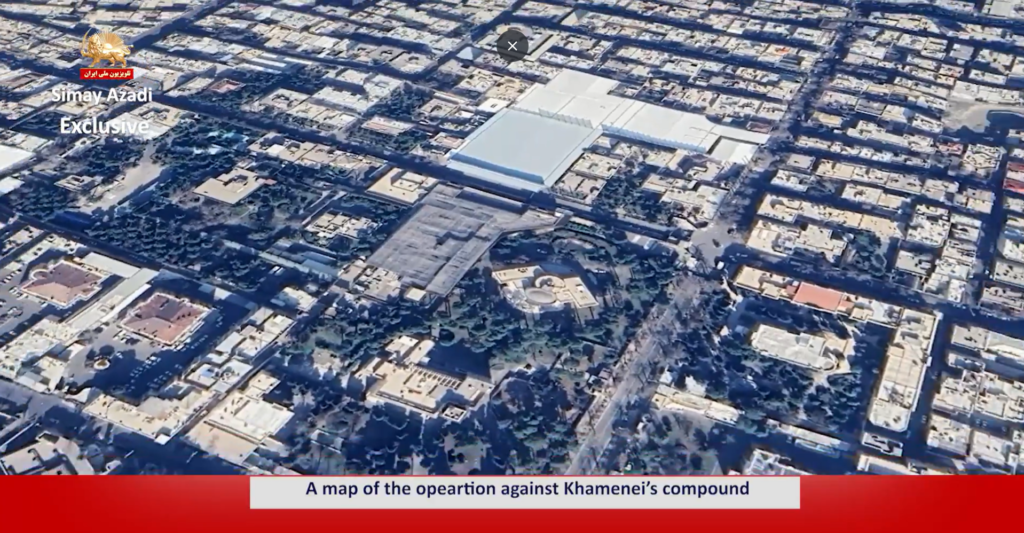
After a long time of denial and downgrading the situation, a regime-affiliated political analyst publicly referred to the People’s Mojahedin Organization of Iran (PMOI/MEK) operation near Supreme Leader Ali Khamenei’s compound in Tehran days before the outbreak of war, offering one of the clearest acknowledgments by a figure linked to the Iranian establishment of the February 23 clashes.  After long time of denial and downplaying the news, a regime-affiliated political analyst has publicly referred to a PMOI/MEK operation near Iran's now-dead Supreme Leader Ali Khamenei’s compound in Tehran just days before the outbreak of war. The remarks amount to one of the… https://t.co/zHFgs9WoXz pic.twitter.com/tT8VAYvKy9 — SIMAY AZADI TV (@en_simayazadi) June 3, 2026 In remarks published in recent days on the Iran Talk channel, regime analyst Mehdi Kharatian referred to what he described as an operation carried out by the People’s Mojahedin Organization of Iran (PMOI/MEK) against Khamenei’s compound on February 23, 2026, just days before the start of the war.  Kharatian said:  “You can see that three or four days before the war, we had the PMOI attack on the Leader’s compound. An attack took place four or five days before the war.”  The comments appear to refer to the large-scale clashes reported on February 23 around the Motahari Complex in central Tehran, which houses Khamenei’s headquarters along with the offices of several key state institutions, including the office of Mojtaba Khamenei, the Supreme National Security Council, the Guardian Council, and other senior government bodies.  During the discussion, host Mohammad Fazeli noted that only fragmented reports had initially emerged about the incident.  “Some incomplete reports came out,” Fazeli said.  Kharatian replied:  “Yes, the organization itself announced it.”  He then claimed that many participants had been captured or killed before they could leave the area.  “Before they could get out, they were immediately dealt with—arrested or killed. The system had understood what was happening and reacted immediately.”  The remarks are notable because Iranian authorities have largely avoided publicly discussing the details of the February 23 operation.  At the time, the PMOI announced that hundreds of its members had participated in an operation targeting Khamenei’s heavily fortified headquarters. The organization said more than 100 members were killed, wounded, or detained during clashes with security forces, while others managed to withdraw from the area. It later released the names of detainees and missing individuals and said the information had been submitted to the United Nations Special Rapporteur and international human rights organizations.  The PMOI also called on UN officials and international observers to seek access to detainees and verify reports of those killed during the operation. According to the organization, additional names of arrested, missing, and deceased participants were later submitted to international bodies as documentation efforts continued.  Kharatian’s comments come amid a broader crackdown on individuals accused of links to the PMOI. In recent weeks, families of political prisoners and PMOI supporters have reportedly been summoned and interrogated by Iran’s Ministry of Intelligence, while relatives of executed prisoners have faced threats and pressure.  Since July 2025,  ten PMOI members have been executed, including Hamed Validi and Mohammad Massoum-Shahi on April 20, 2026, as well as Vahid Baniamerian, Pouya Ghobadi, Babak Alipour, Mohammad Taghavi, Akbar Daneshvarkar, and Abolhassan Montazer.  Kharatian’s remarks represent one of the most direct acknowledgments by a regime-affiliated commentator that a significant confrontation took place around Khamenei’s compound shortly before the outbreak of war, an event that Iranian authorities have largely refrained from discussing publicly. 
Exclusive Interviews, News

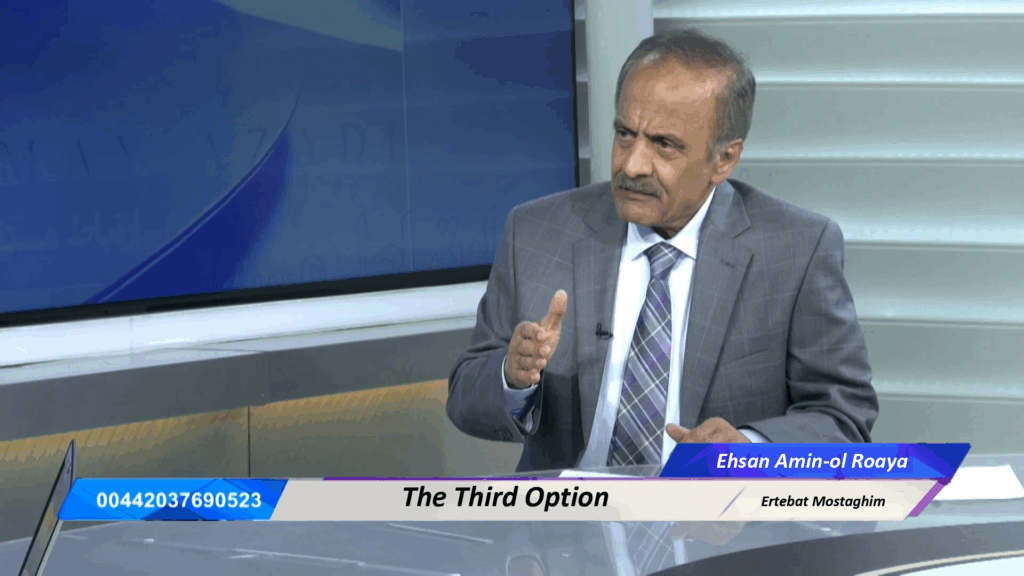
Interview with Ehsan Aminroaya – Iran’s Future: The Third Option Explained

Simay Azadi’s interview with Ehsan Amin-ol-Roaya, a member of the National Council of Resistance of Iran (NCRI). Introduction The 12-day war, which ended with the ceasefire on June 24th, remains the most critical issue for Iran and the world. What are the key takeaways from this war as it pertains to Iran, the ruling regime, and the Iranian people? Now that we are in a ceasefire period, where are events heading? And what is the meaning of the Iranian Resistance’s policy—the “Third Option”—which was reiterated by its President-elect during the war? Perhaps at no time in the past four decades have we faced such a sensitive and perilous moment in our country. We recall that at the beginning of this Iranian year, in March, the leader of the Resistance, Massoud Rajavi, clearly described this situation, stating, “We have entered the most important, sensitive, critical, and turbulent phase: the phase of final determination, where the fate of our people will be decided in their confrontation with the Velayat-e Faqih regime and its accomplices.” He added, “The multiplicity, intensity, and speed of events in this stormy sea are the hallmarks of a volatile revolutionary situation.” We are now in the heart of these conditions. Speculation about the future is rampant. For this very reason, it is essential to focus on the perspective and policy of the Iranian Resistance, which will serve as a guide for action moving forward. We will examine this topic in this week’s “Ertebat Mostaghim” program (live TV discussion). Question 1: Let’s start with the 12-day war. What were the most significant results and effects of this war as they relate to the people of Iran and the nation’s destiny? Ehsan Aminroaya:You speak of destiny—the destiny and future of the Iranian people. While this is a fundamental and paramount issue in this conflict, it is also the question that received the clearest answer. Many of the political and tactical details of this war remain ambiguous and unresolved. But on this great question, a definitive answer emerged from the throes of a horrific experience. What was proven—what became clear and is beyond doubt—is that destiny is shaped by the Iranian people themselves, by their sons and daughters, and by their Resistance, through their own suffering and struggle. Nothing else, nothing else, nothing else. No other factor, no other power, neither wants to nor can turn this dark, blood-soaked page in favor of the millions of oppressed people. It was proven that war is not the answer to the Iran problem. It was proven that bombing cannot overthrow the regime. It was proven that the appeasing Western governments, which for years nursed a viper in their bosom—meaning they strengthened the regime and blocked the path to change—betrayed global peace. Twenty-one years ago, Maryam Rajavi told them loudly in the European Parliament that this appeasement would unleash war upon the world, but they did not listen. #Breaking an excerpt of @Maryam_Rajavi's speech underlining that a dangerous new phase began Friday in Iran and the region—but the real war has raged for 44 years between the Iranian people and the ruling religious fascism. The solution: regime change by the people and their… pic.twitter.com/WDhJIe5RBt — SIMAY AZADI TV (@en_simayazadi) June 18, 2025 And it was proven that those contemptible Iranian factions and individuals—and I don’t mean truly Iranian, but merely Persian-speaking—those phony reformists within the government who praised the Supreme Leader, who congratulated Khamenei on his warmongering in the region, and who opposed the regime’s overthrow, they betrayed the Iranian people and paved the way for this very war. In contrast, it was proven that the only real solution is the Third Option, which the President-elect of the Resistance announced 21 years ago: change by the hands of the people and their organized Resistance. This means neither foreign war nor the appeasement policies of Western governments, but overthrow by the hands of the people and their Resistance. Question 2: During the war, Mrs. Rajavi reiterated the Third Option in a speech at the European Parliament. She stated that the Iranian people welcome an end to the war and, in the first moments of the ceasefire, she welcomed it, saying, “The ceasefire and the end of the foreign war is an advancement for the Third Option.” What does this phrase mean? Ehsan Aminroaya War is not the arena for the people and their Resistance to play a role. War is an arena where governments and ruling powers take control, and the people’s ability to act is stripped away. We welcome the proposal for ceasefire and end of foreign war which we hope will be maintained.This is a step forward for the ultimate solution to this crisis which is regime change by the people of Iran and the organized resistance. pic.twitter.com/j3hCPawBOL — Maryam Rajavi (@Maryam_Rajavi) June 25, 2025 Consequently, war paves the way for anti-popular, dependent, and colonial alternatives—for those who have no substance or merit other than to ride into power on the tanks of foreign, occupying forces. We have seen this in the experience of other countries, but we have also seen it in Iran’s own history. In 1921, when Reza Shah was brought to power, the situation was that British forces had occupied parts of Iran, and as they were preparing to withdraw, they shaped an alternative that suited their own interests, and we saw the result. Two decades before that, Tsarist Russian forces occupied Tabriz, captured Sattar Khan and Bagher Khan (leaders of Iran’s Constitutional Revolution), and prevented them from participating in the liberation of Tehran, effectively blocking the path for a popular alternative. Wherever war and military solutions have receded, the Third Option has been genuinely strengthened. Question 3: If you agree, let’s dissect the Third Option. What are its aspects? What are its foundations, and on what precedents in the positions of the Mojahedin (PMOI/MEK) and the National Council of Resistance is it built? Ehsan Aminroaya In terms of the PMOI’s core principles, the Third Option arises from this movement’s commitment to independence and

Scroll to Top