
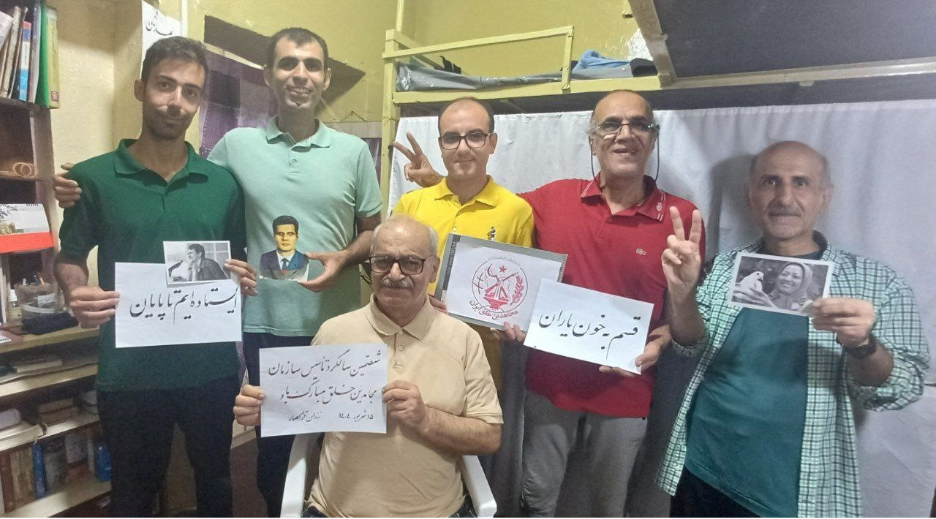
In a report obtained exclusively by Simay Azadi, a fellow prisoner provides a first-hand account of the final moments of six members of the People’s Mojahedin Organization of Iran (PMOI). The six individuals—Vahid Baniamerian, Babak Alipour, Pouya Ghobadi, Mohammad Taghavi, Abolhasan Montazar, and Akbar Daneshvarkar—were executed in pairs between March 30 and April 4.
All six had been sentenced to death on charges related to their membership in the PMOI. Footage of the men singing the anthem “Rise Up, Battalion” while in prison has circulated widely on social media and important international media outlets in recent days. The following account describes the atmosphere inside the prison during their transfer to solitary confinement and their subsequent departure for execution.
Full text of letter (see footnotes for further information)
What a momentous scene it was! How glorious is the station of those human beings who have ground the very snout of death into the dust.
The security forces, wearing black masks and shouting war cries, descended upon the ward deep in the night to slaughter the finest children of Iran. They acted as though their masks could hide them—as if by obscuring their faces from us, they would remain safe from the eyes of history, the people, and God.
Their leader, Kamali—a notorious criminal from the regime’s Prisons Organization—stood there in a misshapen suit, his hair coated in a nauseating dye. Much like Pontius Pilate [1] declaring his innocence during the crucifixion of Christ, he spoke with disgusting hypocrisy: “We are nothing in this! If we don’t carry out these orders, how are we to feed our wives and children?”
Indeed, a scene like the Day of Resurrection unfolded. At 9:15 PM, they attacked us with , tasers, handcuffs, chains, and batons. Akbar Daneshvarkar was at the door; they fell upon him first. His clothes were torn and hanging off his body, yet he shouted with mocking laughter: “Why are you so afraid? We are the ones about to be executed—why are you trembling?” He laughed heartily, his voice ringing out.
Then there was the tall and noble Babak. Despite his broken leg, he stood a head taller than the rest. With that same perennial, soul-soothing smile, he asked: “Is everyone okay?” Even as three guards surrounded him to shackle his hands and feet, he shouldered them aside to embrace and bid farewell to every one of his comrades. They could not stop him.
Mohammad Taghavi, a man of small stature but a giant spirit, was being led away in handcuffs. Even as he walked toward his death, he stopped to help those like Vahid, who had been beaten to the ground; with his own hands bound, he reached down to lift them up. When he reached me, we ebraced. He said, “We must sing a song now.” I replied, “Let us sing.”
He said, “I cannot focus, and no lyrics come to mind… but what anthem is more crushing than The God is Great ?” And so, the echoes of our chants shook the entirety of Unit 4. In that chaotic scene, I saw nothing but grandeur, dignity, and the beauty of the human spirit.
Vahid Bani-Amerian seemed as if he were so light-hearted and relieved. At one point, he fell from the hands of those guards of ruin and crime. While they rained blows with fists and batons upon his head and face, the cry of God is great never left his lips. As I was being handcuffed from behind and he from the front, we came chest to chest. He took my face in his hands and we hugged. He said, “Forgive us… the call for the final journey has sounded. The freedom of Iran and our people is worth all of this.”
Even as they dragged him away, he remained defiant. The officers pulled him through the door while his feet were barely touching the ground. He raised his hand in a V-for-victory sign as they forced him onto the transfer minibus.
Pouya Ghobadi approached me with a radiant face and a beaming smile. He threw his shackled arms around my neck. Seeing my eyes filled with tears, he asked with a smile: “Why? Why the tears? Is it not our faith that ‘Among the believers are men who have been true to their covenant’? If so, what room is there for regret?”
And then there was the young-at-heart elder, Mr. Montazar. He always said that one must go to the gallows with head held high. Truly, he lived those words. He was shackled to another prisoner, yet he pulled his captors this way and that just so he could reach the others for a final embrace.
Yes! These are the heroes of Iran who have forsaken life and family for the freedom of their people from tyranny. They walk to the gallows with pride. Meanwhile, wretches like Kamali, in the presence of these legends of history, grovel for a meager bonus to feed their bellies, seeking only to curry favor with their masters.
That same night, in solitary confinement, I replayed the faces of each of these men in my mind. I thought to Vahid: “If the realization of a free Iran is indeed a ‘Resurrection,’ then you, by rising for freedom, have removed the only remaining veil—the fear of death.”
Peace be upon you for the steadfastness you showed.

Explanatory Footnotes
- Pontius Pilate: A reference to the Roman governor who presided over the trial of Jesus. The witness uses this Western/Biblical reference (which is also known in Iran) to highlight the guard’s attempt to dodge moral responsibility by claiming he was “just following orders.”