
On May 15, Mizan News Agency, linked to Iran’s Judiciary, provided new details regarding operations carried out by four executed members of the Iranian opposition group, People’s Mojahedin Organization of Iran (PMOI/MEK) — Mohammad Taghavi, Akbar Daneshvarkar, Babak Alipour, and Pouya Ghobadi — including involvement in attacks targeting sensitive state institutions.
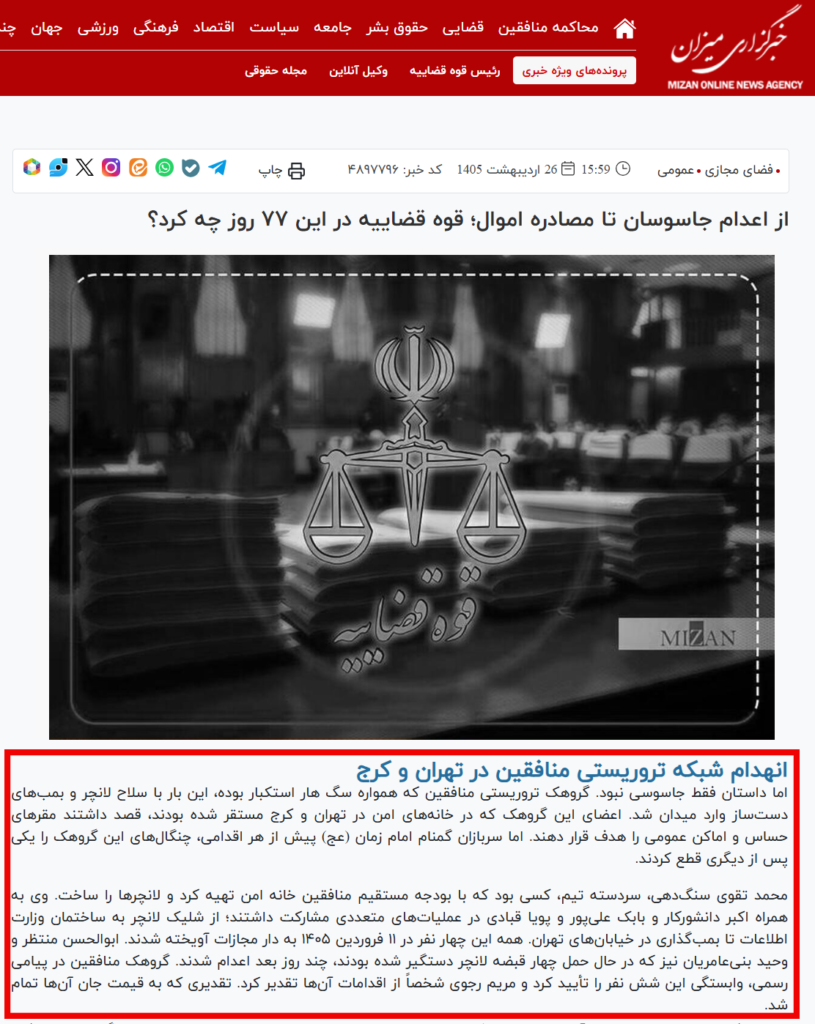
According to reports cited by Mizan and originally attributed to Mehr News Agency, the four men were accused of participating in multiple operations, including a launcher attack on a building belonging to Iran’s Ministry of Intelligence, as well as other actions involving homemade explosive devices.
The report stated that the men had participated in:
“Multiple operations — from firing a launcher at the Ministry of Intelligence building to bomb attacks.”
Authorities also alleged that the group intended to target additional “sensitive centers and locations” inside Iran.
The claims were published weeks after the executions of the four PMOI members and amid broader reporting by Iranian authorities outlining dozens of executions linked to security, espionage, and opposition-related charges.
According to Mizan, Mohammad Taghavi was accused of arranging safe houses in Tehran and Karaj and constructing launchers using funding allegedly connected to the PMOI. The report claimed that Taghavi, together with Akbar Daneshvarkar, Babak Alipour, and Pouya Ghobadi, took part in several operations targeting state institutions.
The allegations are notable because Iranian state and judiciary-linked outlets have rarely publicly acknowledged claims of direct operations against the Ministry of Intelligence itself.
The four men — Mohammad Taghavi, Akbar Daneshvarkar, Babak Alipour, and Pouya Ghobadi — were among six PMOI members executed between March 30 and April 4, 2026, alongside Vahid Baniamerian and Abolhassan Montazer, after convictions on charges including moharebeh (“enmity against God”) and security-related accusations.
Before their executions, videos smuggled from prison showed several of the men singing resistance songs and issuing messages from detention. Their cases drew attention from opposition groups and rights monitors, who raised concerns regarding due process and politically motivated prosecutions.