
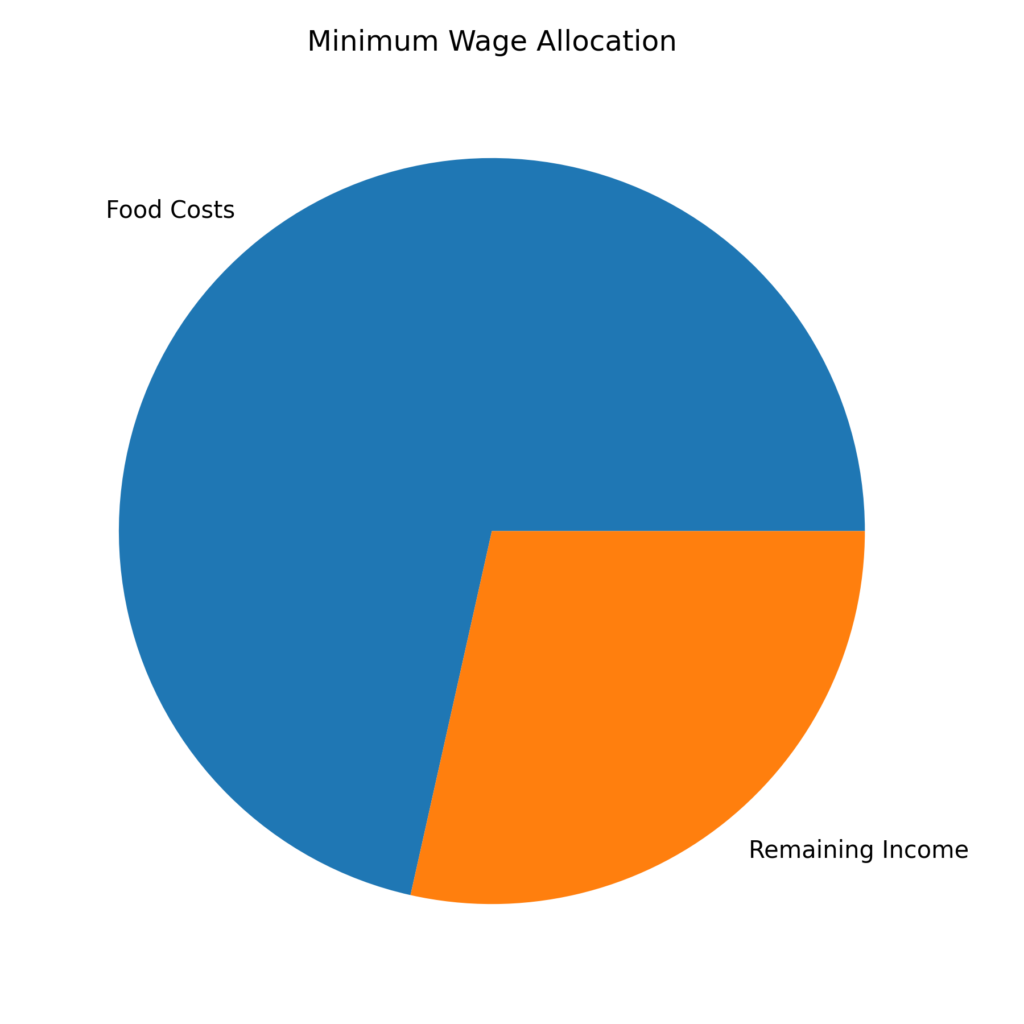
For an Iranian family of four, the cost of basic food items now consumes 71.5 percent of the minimum wage. As Iran’s inflation persists, local publications are signaling that the country’s economy is approaching a threshold where the cost of daily survival may soon exceed the total income of a working-class household.
Reports published by Iran’s state-affiliated media on June 9 and June 10, 2026, provide a stark look at this decline, documenting soaring prices and the rapid erosion of government-provided safety nets.
The Shrinking Safety Net
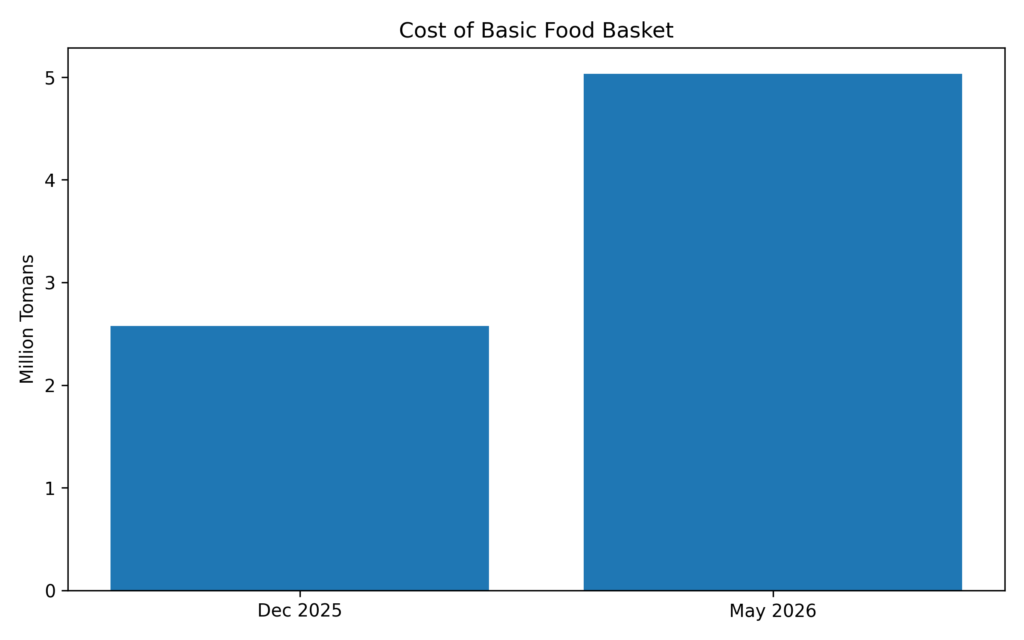
The government’s ““food basket“” program—a metric used to track the cost of essential calories—has become a primary indicator of the crisis. According to Eghtesad News, the cost of a single-person basket rose from 2.576 million tomans (approx. $14.75) in December 2025 to 5.034 million tomans (approx. $28.83) in May 2026.
Eghtesad News highlighted the growing gap between government promises and the reality on the ground:
“The final price of the food basket in May 2026 was 2.457 million tomans [approx. $14.07] higher than the price of the same basket in late December 2025, and the government covers only one million tomans of this price difference.”
The outlet further noted the rapid devaluation of that subsidy:
“The purchasing power of this one million toman credit bears no resemblance to the one million tomans of last winter, or even the value of the same credit this past April.”
While authorities had previously promised to increase food-basket credits to compensate for policy shifts, Eghtesad News reported that government spokespersons have cited “financial constraints” as the reason those commitments have not been honored.
Price Shocks at the Grocery Store
The impact of these rising costs is most visible in dairy, a staple of the Iranian diet. Donya-e-Eqtesad reported that producers are facing simultaneous shocks to their supply chain.
“The dairy industry has faced two waves of rising costs in recent months; on one hand, the price of raw materials and packaging supplies has more than doubled compared to before the war, and on the other, the rise in raw milk prices has placed the main pressure on production costs.”
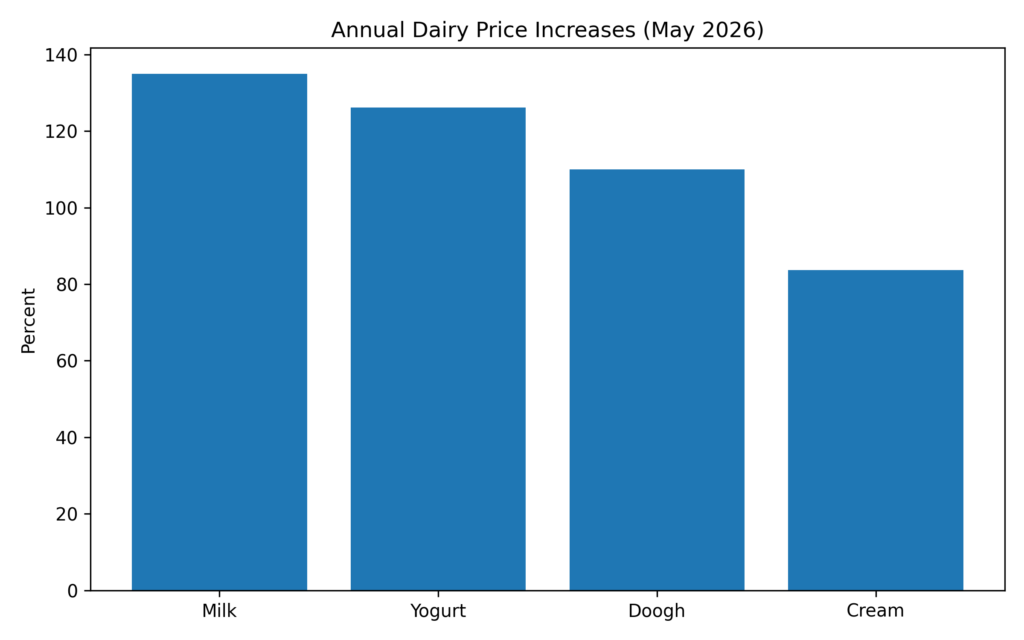
According to inflation data from the Iran’s Statistical Center, year-on-year price increases as of May 2026 include:
Pasteurized milk: 135 percent.
Yogurt: 126.2 percent.
Doogh: 110 percent.
Cream: 83.7 percent.
The Threshold of Sustainability
Beyond food, housing is placing an unsustainable burden on families. In a report published on June 9, 2026, Donya-e-Eqtesad noted that in parts of Tehran, rent alone can consume 60 percent of the minimum wage, while the government-approved housing allowance remains fixed at 3 million tomans (approx. $17.18) per month.
The outlet warned of the broader societal implications if these trends hold:
“If the current inflationary trend continues and the minimum wage remains unchanged in 2026, in the coming months the entire minimum wage could be spent on food expenses.”
The publication attributed these pressures to three primary drivers: the devaluation of the currency, which has spiked the cost of imported goods; disruptions in maritime trade that have limited supply; and the degradation of domestic infrastructure due to the recent conflict.
The report concluded with a somber assessment of how households are attempting to cope:
“To cover these costs, in many households two or more people are forced to work, or the head of the household is forced to work multiple shifts; otherwise, they must forgo their daily caloric intake.”
Editor’s Note: Currency conversions are calculated based on the approximate free-market exchange rate of 174,600 tomans to $1 USD as of June 12, 2026. Data is derived from state-affiliated media reports.