
July 24-25 marks the beginning of the National Liberation Army (NLA) “Eternal Light” operation. The NLA played a key role in forcing the Iranian regime to accept ceasefire.
This study examines the critical factors that led to Ruhollah Khomeini’s acceptance of UN Security Council Resolution 598 on July 18, 1988, effectively ending the eight-year Iran-Iraq War. Contrary to the official state narrative, the decision was not a voluntary move towards peace but a forced concession driven by several important issues, including the military successes of the National Liberation Army of Iran (NLA) and the political campaign of the National Council of Resistance of Iran (NCRI), in addition to a mounting internal and international pressure on the regime. This study consolidates evidence, including admissions from high-ranking regime officials, to demonstrate that the Resistance’s actions were the decisive factor in compelling Khomeini to end a conflict he had vowed to continue indefinitely.
1. The Stated Policy: War Without End
From the outset, Khomeini framed the war as an existential and expansionist crusade. His public stance was one of absolute intransigence, famously declaring, “Even if this war lasts 20 years, we will stand firm.” This policy was ideologically driven by the slogan “The path to Jerusalem passes through Karbala,” which positioned the war with Iraq as a necessary step for exporting his reactionary ideology throughout the region.
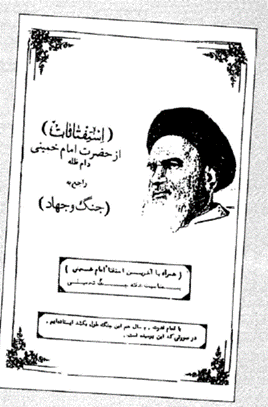
The regime’s leadership was unified in this goal. As the regime’s former president Akbar Hashemi Rafsanjani later stated in a September 2009 interview, there were three primary objectives: “until an Islamic government is established in Iraq,” “until sedition is eliminated from the world, which the Imam also said,” and “until the aggressor is punished and Iran’s rights are secured.” Rafsanjani confirmed that no faction of the regime “was willing to back down from these three demands.”
2. The Human Cost: A Policy of “Disposable Soldiers”
The regime’s commitment to endless war resulted in staggering human and economic costs for Iran:
- Fatalities: 1 million dead.
- Casualties: 2 million disabled and wounded.
- Displaced: 4 million people.
- Economic Damage: Over one trillion dollars, a figure Rafsanjani admitted was equivalent to a century of Iran’s oil revenue.
Lacking adequate military training and weapons to fight Iraq, a cornerstone of the regime’s military strategy was the systematic use of child soldiers.
- The Ministry of Education confirmed that 450,000 schoolchildren were sent to the front.
- Then IRGC Minister Mohsen Rafighdoost stated that in Operation Kheibar (1983), 57% of combat forces were schoolchildren.
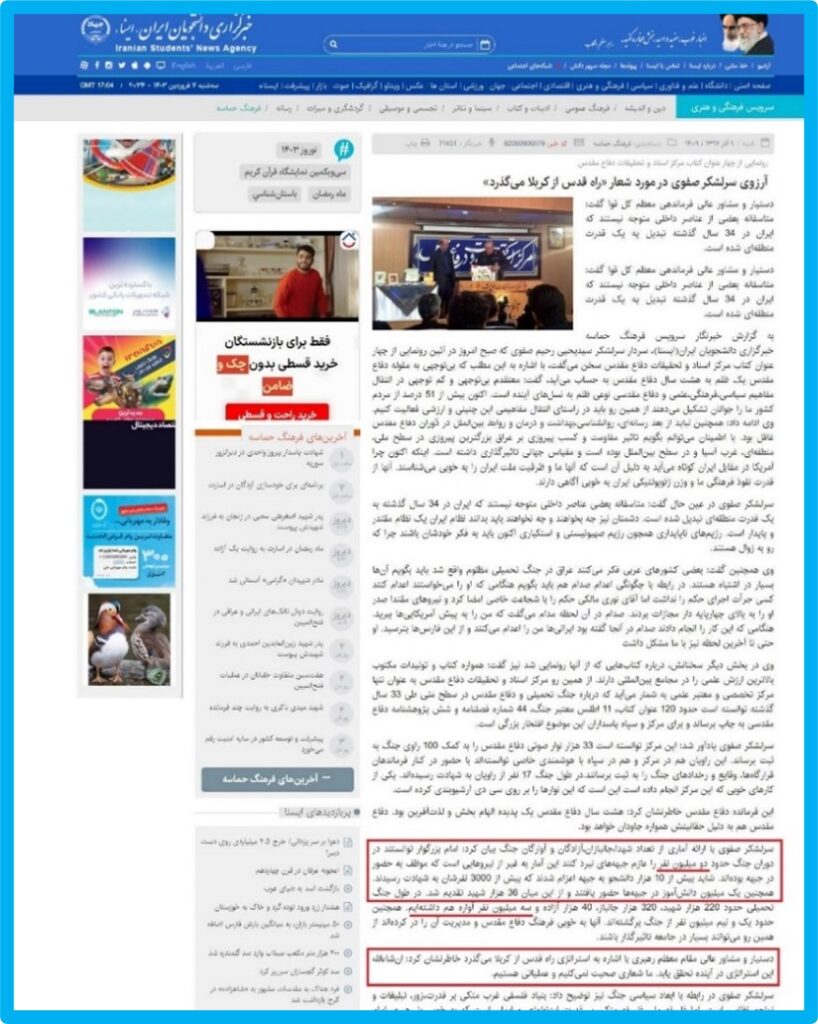
- Major General Rahim Safavi, a senior aide to Ali Khamenei, later confirmed that “one million schoolchildren participated on the fronts,” with “36,000 martyred.“
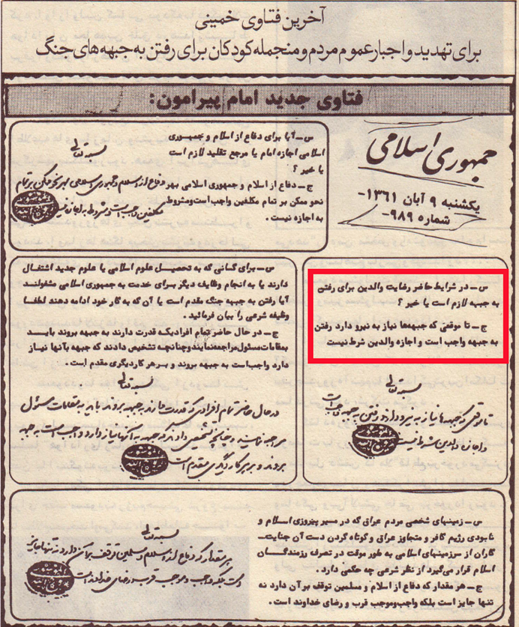
This practice was justified by a fatwa from Khomeini, which stated: “As long as the fronts need forces, going to the front is obligatory, and parental permission is not a condition.” The regime’s Ettela’at newspaper on May 1, 1982, published a chilling account of these children being used to clear minefields, describing how they would “wrap themselves in blankets and roll over the mines, so that the pieces and fragments… would not be scattered so far that they could not be gathered.”
The scale of this crime prompted NCRI Chairman Masoud Rajavi to send a formal message to UN Secretary-General Javier Pérez de Cuéllar on December 1, 1985, warning of the “great danger threatening the lives of more than 10 million Iranian schoolchildren” and labeling it one of the “greatest and most bitter crimes against humanity.”
3. The Alternative Path: The Resistance’s Campaign for Peace
While Khomeini pursued war, the Iranian Resistance advocated for peace. After initially defending Iran’s borders against the 1980 invasion, the PMOI/MEK announced that there is no point in continuing the war following the Iraqi arm’s withdrawal from most Iranian territory in June 1982. At that time, Iraqis withdrew from the port city of Khorramshahr, and signaled readiness for a ceasefire.
From that point, the Resistance deemed the war “anti-patriotic” and launched a multifaceted peace campaign under the slogan “Peace and Freedom.” This initiative was unique. Ali Shamkhani, the regime’s former Minister of Defense, admitted on September 26, 2005:
“No one, absolutely no one, other than the Mojahedin, exists inside the country who, after Khorramshahr, issued a statement… that the war must end… There is no document showing that any other political group demanded the situation that they claim today.”
The NCRI’s diplomatic efforts led to a peace declaration with Iraq’s Deputy Prime Minister in December 1982 and a formal peace plan in February 1983, which Iraq accepted as a basis for negotiations. These actions politically shattered Khomeini’s pretext for continuing the war.
4. A Decisive Iranian Factor: The National Liberation Army (NLA)
With all diplomatic paths blocked by Khomeini, the conflict was ultimately decided on the battlefield. Between 1987 and 1988, the NLA launched one hundred military operations. The campaign culminated in June 1988 with Operation Chelcheragh, which resulted in the capture of the strategic city of Mehran, western Iran.
This operation was a catastrophic military defeat for the regime. The NLA seized over $2 billion in weapons and equipment from two elite divisions: the 16th Armored Division of Qazvin and the 11th Anti-Amir al-Momenin Division.
The victory gave rise to the slogan “Today Mehran, Tomorrow Tehran,” which, according to Khomeini’s own inner circle, became his ultimate “nightmare.” The prospect of the NLA advancing on the capital created a new balance of power.
5. The Collapse: Khomeini’s “Poison Chalice”
Less than a month after the fall of Mehran, on July 18, 1988, Khomeini accepted UN Security Council Resolution 598. He described the act as drinking a “chalice more bitter than poison” and admitted that he “did not deem it expedient to publicly state the reason.”
His son, Ahmad Khomeini, later described his father’s anguish: “The Imam repeatedly struck his fist on his thigh, crying out in pain… After accepting Resolution 598, for several days, the Imam could not walk properly.”
High-ranking officials, including then-Foreign Minister Ali Akbar Velayati and then-IRGC commander Mohsen Rezaei, later confirmed that the primary reason for accepting the ceasefire was the military threat posed by the PMOI after the capture of Mehran.
Conclusion:
The evidence demonstrates that Khomeini’s decision to end the Iran-Iraq War was not a strategic choice for peace but a forced capitulation. Faced with a collapsing military front, a viable political alternative championing peace, and the decisive victories of the National Liberation Army, his regime was left with no other option for its survival.