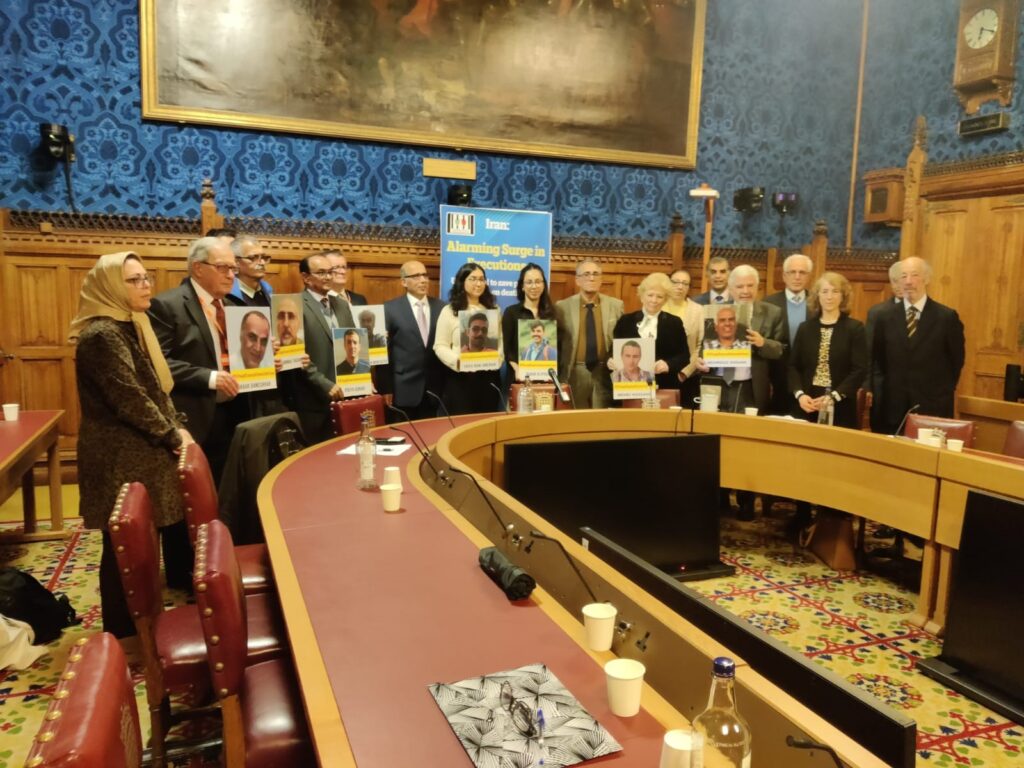
On Tuesday, January 28, 2025, a conference was held at the UK Parliament titled “Iran: The Alarming Surge in Executions”, marking the first anniversary of the No to the Executions Tuesdays campaign.
The event, organized by the Association of Former Political Prisoners in the UK, brought together parliamentarians, human rights activists, and survivors of Iran regime’s brutal prison system to discuss the worsening human rights crisis in Iran and the urgent need for action to prevent further executions of political prisoners.
A Coordinated International Call to Action
The conference took place against the backdrop of an ongoing global campaign protesting the imminent threat of execution of two political prisoners, Mehdi Hasani and Behrouz Ehsani. The recent transfer of these two supporters of Iran’s main opposition group, People’s Mojahedin Organization of Iran (PMOI/MEK) to Ghezel Hesar Prison has raised grave concerns among human rights advocates, prompting widespread calls for international intervention.
Narges Rahmanfard, who chaired the session, opened the discussion by underscoring the importance of the event in highlighting Iran’s escalating human rights crisis. She condemned the Iranian regime’s growing use of executions, particularly against political prisoners, and urged the international community and UK lawmakers to take immediate action. She emphasized the ongoing global campaign to stop the execution of Mehdi Hasani and Behrouz Ehsani underlining the importance of standing in solidarity with the Iranian people in their fight for justice. She described the session as an opportunity to amplify the voice of the Iranian Resistance and those facing repression.
MPs and Lords who spoke at the session highlighted the Iranian regime’s systematic use of executions as a tool of repression and called for decisive international action. Jim Shannon MP, Chair of the All-Party Parliamentary Group for Freedom of Religion or Belief, emphasized the moral duty of parliamentarians, stating, “Behind the alarming rise in executions, I recognize the role we as MPs must play. I pray for Iran every day, for its people, for its liberty and democracy. Along with many others, I will do my best in this house to bring about changes that matter.”
Lord Whitty, former UK government minister and Labour life peer, called for a stronger response from the UK and its allies, saying, “Western governments particularly have a responsibility here. Too many are turning a blind eye. My government must take steps, including the proscription of the IRGC, and work with allies to ensure that the regime receives no economic or political support. The world must not treat Iran as just another government, but as a blot on humanity.”
Baroness O’Loan, crossbench member of the House of Lords and former Police Ombudsman for Northern Ireland, strongly condemned the execution process in Iran, declaring, “The judiciary and executions in Iran are not about justice; they are tools of oppression aimed at silencing dissent. The UK must take two overdue actions: proscribing the IRGC as a terrorist organization, as the U.S. and Canada have done, and leading international efforts at the UN to hold the regime accountable.” She also praised the role of Mrs. Maryam Rajavi, the President-elect of the National Council of Resistance of Iran (NCRI).
David Pinto-Duschinsky, Conservative MP for Henley and a member of the Foreign Affairs Select Committee, dismissed the idea that Iran’s leadership has shown any sign of moderation, stating, “Despite a so-called moderate president, we are witnessing hundreds of executions and a complete denial of rights to the Iranian people. Their legitimate demands for a voice in their own future are being crushed.”
Dawn Butler, Labour MP for Brent Central and former Shadow Secretary of State for Women and Equalities, reflected on the global community’s failure to act decisively, stating, “When we hear about what’s happening in Iran, we think—how can this still be happening in our lifetime? How can we watch this unfold before our eyes and not do more?”
William Powell, former Liberal Democrat Member of the Welsh Assembly, spoke about the fragility of the Iranian regime, saying, “Nothing is more powerful than hearing the voices of those who have sacrificed for their principles. The Iranian regime may still wield power and tools of oppression, but it remains deeply fragile. That makes our efforts now more crucial than ever.”
Testimonies from former political prisoners provided first-hand accounts of the brutal torture and psychological torment inflicted on detainees.
Ahmad Ebrahimi, chairman of the Association of Former Political Prisoners in the UK and a survivor of the 1988 massacre of 30,000 political prisoners, shared his experience of spending a decade in Iran’s prison system. He described the widespread use of torture, forced confessions, and the horrific execution process.
Jamshid Adhami, a former prisoner, described the trauma he witnessed: “I saw how people were tortured, how they executed prisoners. The most painful thing was hearing women and girls being tortured. Today, we are the voice of the voiceless. We must put an end to this brutality.”
Reza Rahmanfard emphasized the urgency of international unity, stating, “Let’s not forget the names of Mehdi Hasani and Behrouz Ehsani. Right now, they are enduring difficult days in solitary confinement. In such moments, international solidarity becomes more critical than ever.”
Neda Zabeti, representing Iranian youth, condemned Iran’s execution system, saying, “Executions in Iran are not about justice; they are instruments of control and repression. The regime continues to act with impunity. We must stand with the Iranian diaspora, support the campaign for justice for the victims of 1988, and demand the proscription of the IRGC.” She also shared a personal testimony, revealing, “My father’s aunt was thrown into prison while pregnant. She gave birth there and raised her baby behind bars for the first three years of its life. My father’s uncle was tortured to death, and his body was thrown into Evin Prison as a warning to others. The suffering in Iran runs deep, and the regime’s brutality touches nearly every family.”
The Unprecedented Rise in Executions
Speakers underscored the staggering escalation in executions in Iran, particularly since the appointment of Masoud Pezeshkian as president. Reports indicate that at least 774 executions have been carried out since August 2024, including 127 in the last month alone—an 80% increase compared to the previous year.
Some of the speakers of this event also highlighted this issue.
Baroness O’Loan addressed this sharp rise, stating, “As we heard, over a thousand executions took place last year. This is a very clear indication of the ongoing horror in Iran. The regime is using these executions to terrorize the population into submission.”
William Powell echoed this concern, emphasizing that while the Iranian regime appears strong, its reliance on mass executions is a sign of its underlying fragility.
The conference also shed light on the fate of eight MEK supporters sentenced to death under unjust trials for “Baghi” (armed rebellion). These individuals were subjected to torture, forced confessions, and denied fundamental legal rights, including the right to independent legal representation.
Recommendations and Demands for Global Action
In response to these alarming developments, speakers urged the UK government and the international community to take decisive action to prevent further atrocities. The key recommendations included:
• Immediate revocation of death sentences and the release of political prisoners
• Official recognition of the National Council of Resistance of Iran (NCRI) and endorsement of Maryam Rajavi’s Ten-Point Plan
• Designation of the Islamic Revolutionary Guard Corps (IRGC) as a terrorist organization
• Expansion of sanctions and international pressure against the Iranian regime
A Closing Message of Solidarity
The session concluded with a unified call for urgent action to prevent further executions and hold the Iranian regime accountable for its crimes. Attendees reaffirmed their support for the Iranian people and their organized resistance, emphasizing that sustained international pressure is key to achieving justice and democracy in Iran.