
By Amir Pasha Borjkhani
On June 13, 2025, war erupted between Israel and the Iranian regime. While many analysts speculated about the conflict, the true struggle soon became undeniable: Iran people’s enduring battle against the ruling theocratic regime, led by their organized Resistance. This was the central focus of two significant conferences held at the European Parliament on June 18.
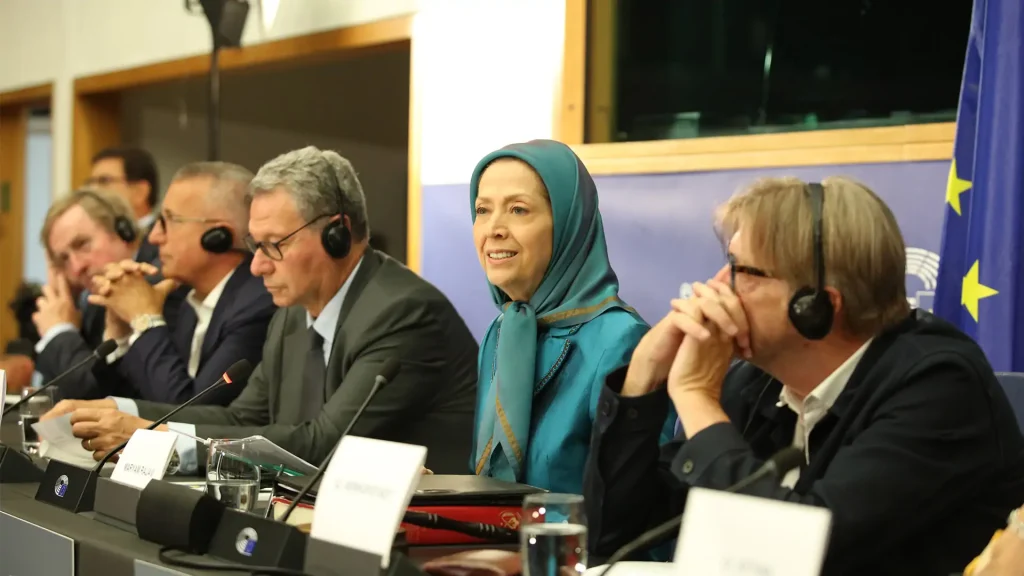
My colleagues and I were also in Strasbourg to cover this event. There, Mrs. Maryam Rajavi, president-elect of the National Council of Resistance of Iran (NCRI), spoke alongside MEPs such as Javier Zarzalejos, Antonio López-Istúriz White, Petras Auštrevičius, and Pekka Toveri as well as distinguished European figures including Guy Verhofstadt, former Belgian Prime Minister and MEP, Enda Kenny, and former Prime Minister of Ireland. Their speeches shed light on Iran’s escalating crisis.
Mrs. Rajavi, the keynote speaker, delivered a captivating and insightful address. She declared that the “crisis of overthrow has now engulfed the entire clerical dictatorship” and described the war as “the beginning of a critical new chapter—both in Iran’s internal crisis and in the broader dynamics of the region.” Yet, she emphasized that the core conflict, spanning 44 years since June 20, 1981, remains the Iranian people’s struggle against the theocratic regime.
For decades, the NCRI, led by Mrs. Rajavi, has championed the “Third Option”: regime change driven by the Iranian people, rejecting both war and appeasement. Recalling her 2004 address to the European Parliament, Rajavi reminded the audience of her warning that “the policy of appeasement encourages the clerical regime to persist in its policies and, ultimately, imposes war upon Western nations.”
Setting the record straight, she stated, “From the outset, our Resistance made it clear: a viper never gives birth to a dove, and a religious dictatorship is inherently incapable of reform.” Instead of requesting material support, Mrs. Rajavi appealed to the MEPs: “We do not seek money, nor do we ask for weapons. What we have always wanted is to resist—just as Europeans once did—against theocratic tyranny. We only ask that this Resistance be recognized. Nothing more.” She criticized the international community for denying the Iranian people and their Resistance “this most basic right.”
European speakers amplified Rajavi’s call for the Third Option, emphasizing the Iranian people’s role in achieving regime change.
“The regime in Tehran has managed for years to deceive those who viewed it as a potential partner for stability in the Middle East. It has always been the temptation to exchange democracy and freedom for stability,” said MEP Zarzalejos, who presided the first conference in this regard.
“In the end, you get no stability and you get no democracy. Today, we must face reality. The time for illusions is over. The threats posed by this regime can no longer be deferred. And this is why Mrs. Rajavi’s vision is important,” he added.
MEP Antonio López-Istúriz White praised the NCRI’s democratic vision, saying, “Madam Rajavi, you noted the council will dissolve once Iran’s elected assembly is formed. Few organizations make such a promise. That gives reassurance.”
MEP Petras Auštrevičius highlighted Mrs. Rajavi’s proactive role, stating, “Madam Rajavi’s 10-point plan proves you shape Iran’s events, not just follow them. This upheaval could lead to regime change and a democratic future.”
MEP Pekka Toveri urged EU support, declaring, “Iranians lead their future, but the EU has means and must find the will to act. A democratic Iran ensures our safety.” In an interview afterward, he elaborated, “There was a lot of discussion and very strong support from EU parliament members to continue support to Iran. We know that the fight is not in the end. This is probably the beginning of the end, but we have a good chance to create a free, democratic Iran.”
Former Prime Minister Enda Kenny commended Mrs. Rajavi’s self-reliance, noting, “Madam Rajavi, you want Iran’s people to overthrow the regime, not foreign entities. This parliament must offer coherence and understanding.” In a post-conference interview with Simay Azadi, he reinforced this, saying, “The solution to the problem in Iran lies with the Iranian people. It’s been made perfectly clear that there is no wish to have an outside change imposed upon Iran, nor is there a seeking of financial assistance to bring this about. It will happen, as happened in every case since the overthrow of Marcos in the Philippines so many years ago.”
Guy Verhofstadt linked democracy to security, asserting, “A democratic Iran prevents a nuclear threat. We must recognize the NCRI as the Iranian people’s true representative.” In an interview following the event, he stressed, “Western leaders, American and European, can do a lot now in this existential moment for the Iranian people. And that is to recognize the democratic opposition as the only legal representative of Iran and the Iranian people. That would give enormous courage to the Iranian people because they will know that there is a future without the mullah regime.”
As I left the conferences, I couldn’t shake the weight of what I’d heard. Mrs. Rajavi’s vision, echoed by these European leaders, painted a path forward driven by the Iranian people themselves. Their words lingered, leaving me to wonder how the world might respond to this call for change.