
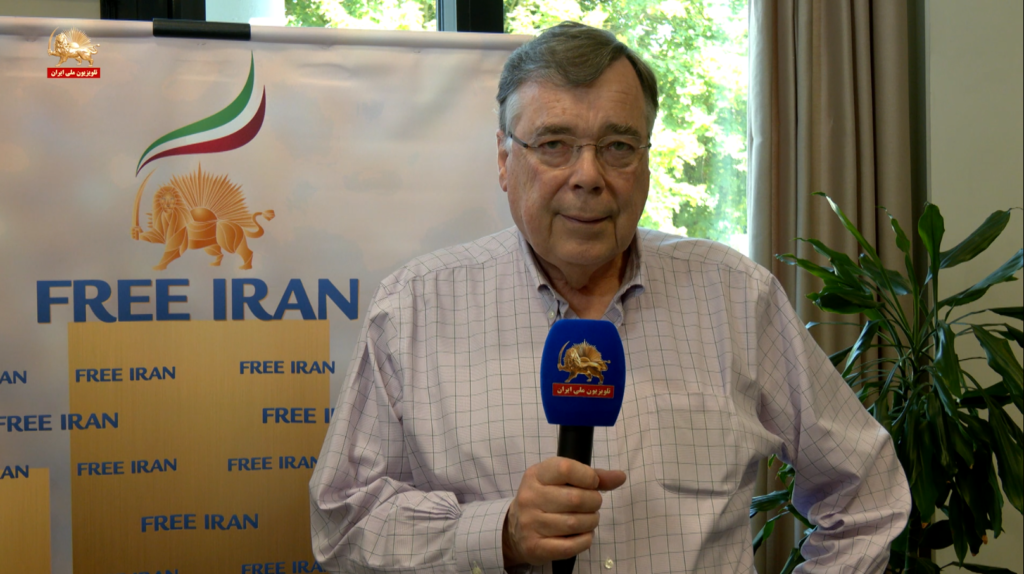
The former Icelandic prime minister discusses the Free Iran World Summit, executions in Iran, the NCRI’s Ten-Point Plan, and the alternative to the current regime.
In an interview with Simay Azadi on the sidelines of the Free Iran World Summit in Paris, former Icelandic Prime Minister Geir Haarde discussed the significance of this year’s gathering, the wave of executions in Iran, international support for the Iranian Resistance, the National Council of Resistance of Iran (NCRI), the cancellation of the Free Iran rally in Paris, and prospects for democratic change in Iran.
During the interview, Haarde argued that growing international support for the Iranian Resistance reflects a better understanding of the situation inside Iran. He said the Iranian people reject both the current religious dictatorship and a return to monarchy, endorsed the NCRI’s Ten-Point Plan, criticized the cancellation of the Paris rally, and reiterated that neither war nor appeasement offers a solution to Iran’s crisis.
Read the full text of the interview below (edited for clarity):
Q: Thank you very much, Mr. Haarde, for being with us. First of all, I wanted to hear your thoughts on this year’s gathering. What was your main message at the Free Iran World Summit?
Geir Haarde: First of all, I think this year’s conference was a great success, apart from the fact that the French authorities blocked the rally that was supposed to take place on Friday. That was a great shame.
I believe behavior like that by the authorities will only strengthen the Resistance movement and reinforce its determination.
As for the conference itself, many important points were raised and a great deal of valuable information was presented.
I emphasized the importance of rallying around the National Council of Resistance of Iran and its Ten-Point Plan.
I also spoke about the executions that take place regularly in Iran, where opponents of the regime are essentially executed without justice. It is a terrible thing to witness.
I have the greatest respect for those who have sacrificed their lives in this way.
There was also discussion about the current negotiations between the United States and the mullahs’ regime, as well as the recent memorandum of understanding.
I believe important issues are missing from that agreement, including a condemnation of the executions.
We must all understand that this cannot be the future government of Iran.
Q: How do you explain the growing number of dignitaries from Europe, the United States, and elsewhere who continue to support the Free Iran movement and participate in these annual gatherings?
Geir Haarde: I think it’s because more and more people understand what is happening in Iran and how the situation has evolved.
We believe the Iranian people do not want this theocracy to continue, but they also do not want a return to the Shah and that type of regime.
“No more dictatorship” is the message people are sending.
More and more current and former politicians in Europe, the United States, and elsewhere understand that the Iranian people need support.
Ultimately, the Iranian people should have the government they deserve and so clearly want.
Q: There have been campaigns promoting the son of the former Shah. What is your view of those efforts?
Geir Haarde: I think the people who promote that idea are on the wrong side of history.
That family belongs to the past, and I do not believe the Iranian people would support a return to a monarchy or a new dictatorship under another Shah.
Q: You have participated in many Free Iran gatherings over the years. On a personal level, what has impressed you the most, and what has motivated you to continue supporting this movement?
Geir Haarde: I began following this movement several years ago after being invited to attend some of its gatherings.
What has impressed me most is the endurance of the movement, the strength of its leadership, and the persistence of the people who work tirelessly for this cause.
It is also remarkable how many distinguished people participate.
Yesterday’s conference included experienced American politicians and former officials who contributed significantly to the discussion.
The same is true of our European colleagues, who know a great deal about the situation.
Coming from a country that has not been deeply involved in these issues, I have learned a great deal over the years about Iran and about the need for regime change.
Q: Based on your understanding of the situation in Iran, what would be your main advice to the international community and to policymakers?
Geir Haarde: I would repeat the words of Madam Rajavi.
First, war is not the answer.
Second, appeasement is not the answer.
The third option is an uprising by the Iranian people that ultimately brings down this deeply unpopular regime.
I believe that is the right path.
Taken together, I think the chances are greater today than they have been in recent years that Iran will eventually have a different government and no longer be ruled by a theocracy.
To the viewers inside Iran, I want to say this:
I admire your strength.
I admire your courage.
Remain persistent.
Remain courageous.
In the end, you will prevail.