
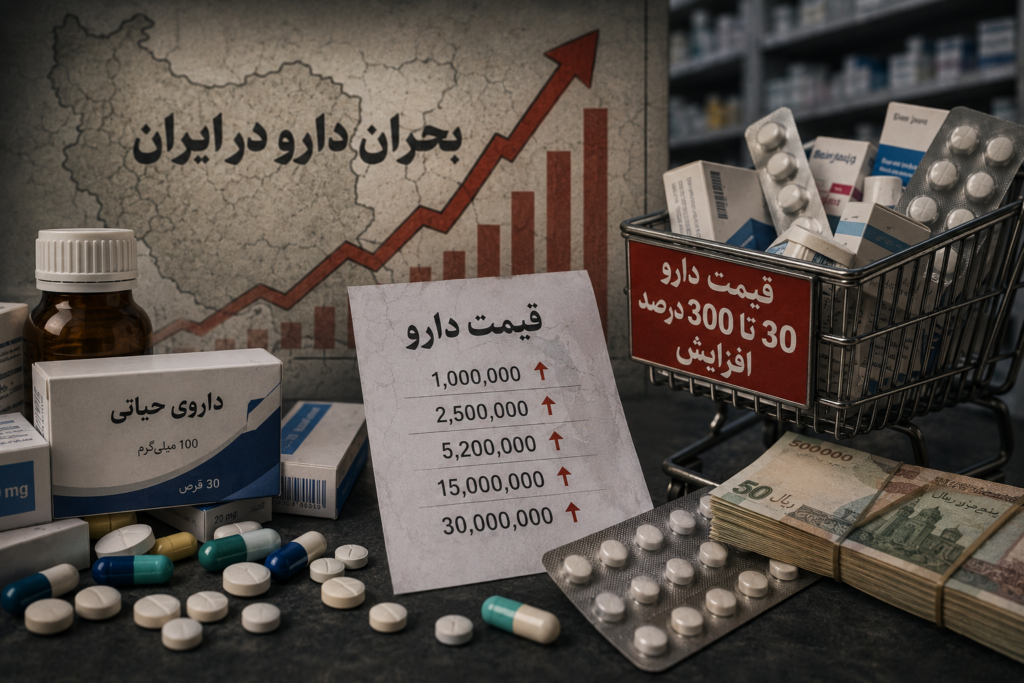
Simay Azadi – Iran’s state-run Etemad newspaper has reported that the country’s medicine crisis has sharply worsened following the recent war and amid what it described as a “fragile ceasefire,” with some drug prices increasing between 30 and 300 percent.
According to the report, officials from Iran’s Pharmacists Association said declining foreign currency reserves and reduced government ability to subsidize medicine production and imports have triggered severe shortages and soaring prices.
Etemad quoted a cancer patient identified as “Azar M.” as saying: “Before the war, I could obtain this medication with insurance support for less than one million tomans. Now, since the outbreak of the war, I have to buy each dose of Xgeva at the non-subsidized price of 30 million tomans.”
The newspaper also described shortages of insulin, cancer drugs, laboratory kits, and imported infant formula, while pharmacies have reportedly begun rationing medicines because of fears of future shortages.
State-linked reports attributed part of the crisis to sanctions, disruptions in shipping routes, rising currency exchange rates, and damage caused during the recent conflict, including attacks affecting pharmaceutical infrastructure.
However, the crisis has also exposed deeper structural problems inside Iran’s pharmaceutical sector, which for years has faced accusations of corruption, instability, and financial mismanagement.
Large parts of Iran’s pharmaceutical and medical import sectors are controlled by economic conglomerates linked to institutions under the authority of the Supreme Leader and the Revolutionary Guards, giving politically connected networks significant influence over medicine production, imports, and distribution.
Among the most influential players is the Execution of Imam Khomeini’s Order, known as Setad, a vast economic empire directly controlled by the Supreme Leader. Through subsidiaries such as the Barkat Pharmaceutical Group and the Barakat Foundation, the conglomerate has expanded into nearly every layer of Iran’s pharmaceutical industry, including medicine manufacturing, imports, vaccine production, and hospital drug supply.
Investigations and reports during the COVID-19 pandemic showed that several executives connected to Barakat simultaneously held influential regulatory positions inside Iran’s Health Ministry and Food and Drug Administration, blurring the line between regulators and major pharmaceutical interests.
Former and current officials inside the health sector have repeatedly acknowledged that state-imposed pricing policies, delayed government payments, weak insurance systems, and overlapping bureaucratic control have pushed many pharmaceutical producers toward bankruptcy.
Despite inflation constantly rising, authorities reportedly restricted medicine price increases to around 15 percent for long periods, severely reducing profitability for manufacturers while simultaneously weakening domestic production capacity.
Officials from the pharmaceutical sector have also warned that government institutions and insurance organizations accumulated massive unpaid debts to drug companies and pharmacies, creating liquidity shortages that crippled production cycles and forced companies into high-interest borrowing.
At the same time, indirect subsidy systems and distorted currency policies reportedly fueled medicine smuggling and corruption networks, further reducing supplies available to ordinary patients inside Iran.
The crisis has increasingly affected daily life for ordinary Iranians. One man quoted by Etemad described seeing a citizen plead with a pharmacy to accept his wristwatch in exchange for urgently needed medication.
While the recent war intensified supply disruptions, the rapid deterioration of Iran’s pharmaceutical sector has increasingly highlighted broader questions about governance, corruption, state priorities, and decades of economic policies that left the healthcare system vulnerable long before the latest conflict.